Blog

Impact of phylogeography and landscapes on the structure of release calls in the Mongolian toads, Strauchbufo raddei

New collaborative study from across northeast Asia! Also explained on YouTube! There is no strong relation between evolutionary history and the structures of release calls as release calls must be conserved to be effective as sex recognition and anti-predator alarms. Contrary to earlier findings, here we provide evidence on the effect of landscape barrier and past glaciations on the patterns of phylogeography and release call variability, using the widespread Mongolian toad Strauchbufo raddei distributed across East Asia as study model.

Here, we enforced a fossil-calibrated relaxed clock to estimate the temporal pattern of divergence and to reconstruct the mitochondrial phylogeography of S. raddei across East Asia (Figure 1). Additionally, we inferred the population dynamic of the Mongolian-Russian clades (N taxa = 147) over the last glacial periods, and we compared the geographic variations in the release calls for the clades occurring in either side of the Hentiyn mountains range, the Transbaikal area and the Amur River basin. Molecular dating suggested a basal split between two lineages: the northeastern- and southern-originated of S. raddei c. 15.00 to 9.00 Mya. Ancestral range estimation elucidated the emergence of southern-originated lineage c. 6.80 Mya by dispersals, and supported a southern range expansion towards the central Asian steppes and a northern expansion towards present-day Transbaikal area c. 2.60 Mya (Figure 1).
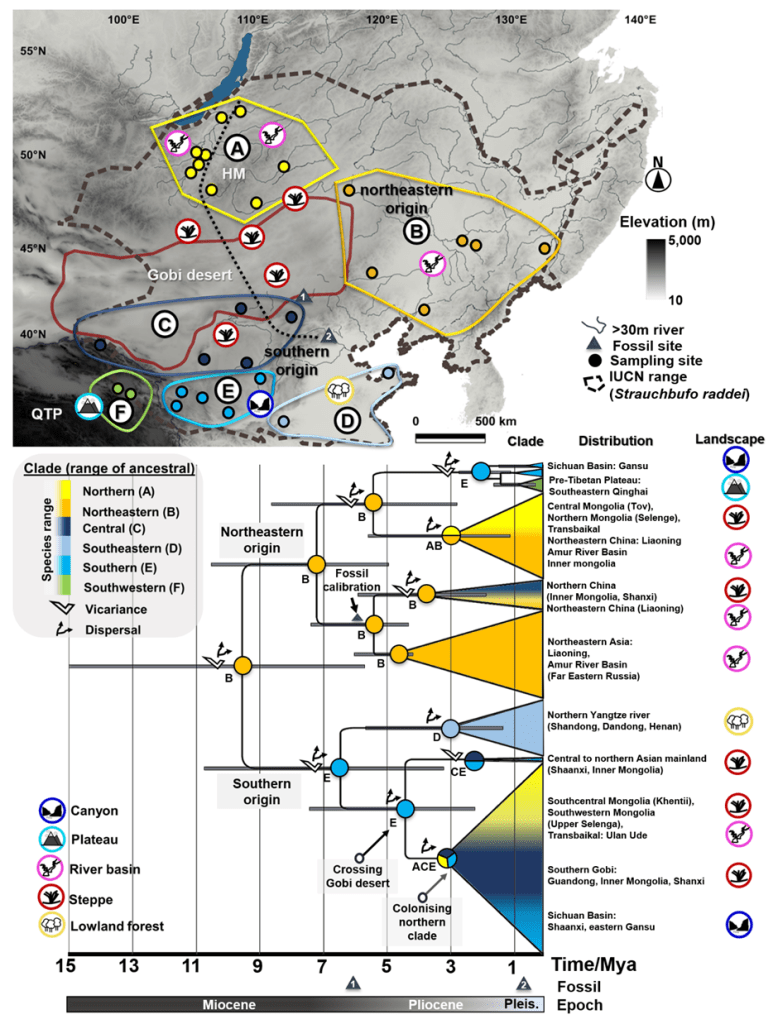
Figure 1. Calibrated tree with estimated divergence for Strauchbufo raddei (N = 288) inferred from 893 bp of the CR fragment. The colour for the clades and the origins of ranges are similarly colour coded. The specific landscape for each clade (N = 6) is embedded next to the corresponding node of the timetree.

Our findings also supported significant differences in the release calls between the isolated north-western Hentiyn clade and the eastern Hentiyn clade distributed widely across the Amur River Basin (Figure 2). Likely, the variation in the release calls attributes to the recent population expansion for one of the northern clades supported the pattern of post-glacial northern refugia restricted to the west margin of Hentiyn Mountains, and Transbaikal area for the southern lineage (Figure 2). Therefore, we clarified that release calls of the Mongolian toad reflect the phylogeographic structures within the clades.

Figure 2: Oscillogram, tree time and release call characteristics of Strauchbufo raddei from two divergent clades. The bar chart shows the geographic variations between the calls of the two lineages: the northeastern clade (orange) and the southern originated clade (blue) in Mongolia and Russia. The colours on the map match with the colours of the bar charts. The release call characteristics that significantly differed between the two clades (call duration, rise time and fall time) are described in the oscillogram.

Othman S. N., Choe M., Chuang M.-F., Purevdorj Z., Maslova I., Schepina N., Jang Y. & Borzée A. (2022). Across the Gobi Desert, impact of landscape features on the biogeography and phylogeographically-structured release calls of the Mongolian Toad Strauchbufo raddei in East Asia. Evolutionary Ecology. In press. DOI: 10.1007/s10682-022-10206-4

从野外到我们的餐桌:运用多种手段解译东北亚林蛙贸易的隐蔽性

实验室新发表的关于东北亚林蛙(Rana sp.)贸易的论文,论文阐明了隐种的划定,以及用于物种识别的形态学方法,以避免对鉴定有误的个体开展交易。

两栖动物的国际贸易增加了全世界和东北亚的物种入侵风险。为了解该地区的两栖动物贸易状况,我们首先开发了物种精准鉴定方法及工作流程,以指导大规模的物种鉴别,分析物种贸易路径;进而,利用进口到韩国的隐种林蛙检测我们的工作流程有效性。

在校准的时间树上确定OTUs的比较物种划界和匹配的比较形态计量学。

该工作流程结合了形态计量学、系统发育特征、物种鉴定模型和系统地理学,从进口到韩国的171个标本中成功鉴定出三种非本地物种:中国林蛙、黑龙江林蛙和高原林蛙。

使用机器学习法和贝叶斯因子定界法评估四种常用的物种鉴定、分类模型(BLAST、ABGD、sGMYC和bPTP),并从171个个体中分离出12个分类单元(OTU)。然后,我们将来自12个OTU的信息进行组合,建立16S系统发育树,包括交易标本和对照标本(n=230)。

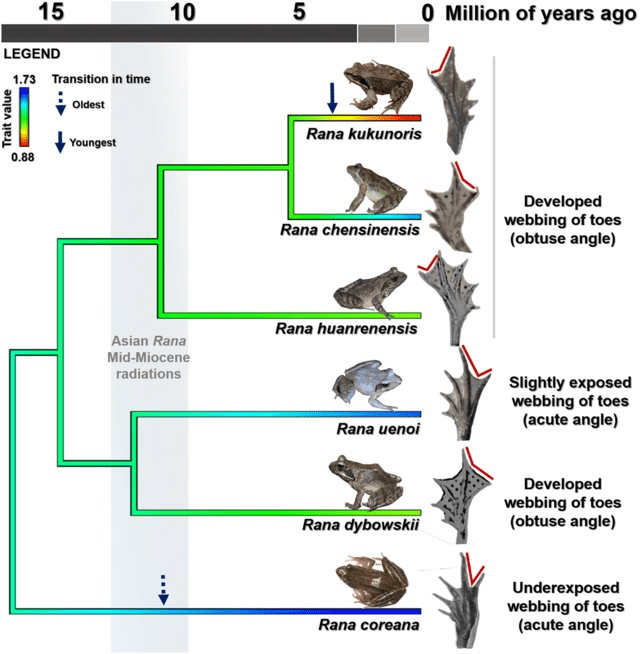
中新世以来东北亚部分选定林蛙趾蹼的表型演化。

基于模型的OTUs和系统发育揭示了贸易的林蛙个体可能广泛来源于野生环境,它们养殖场循环,然后融入合法贸易。除了遗传因素外,我们的形态计量学结果还表明,韩国特有物种,特别是桓仁林蛙和贸易中涉及的林蛙之间具有极高的表型隐蔽性。

然而,性状进化结果也点明了过去12.0 Mya中,林蛙趾蹼的独立进化模式,这很可能是整个东北亚林蛙物种鉴别的一个非常有用的关键特征。基于本文开发的大规模物种鉴别工作流程,我们建议东北亚地区制定林蛙物种贸易监测机制,并制定相关法律。

Othman S. N., Shin Y., Kim H.-T., Chuang M.-F., Bae Y., Hoti J., Zhang Y., Jang Y. & Borzée A. (2022).Evaluating the efficiency of popular species identification analytical methods, and integrative workflow using morphometry and barcoding bioinformatics for taxonomy and origin of traded cryptic brown frogs.Global Ecology and Conservation. 38:e02253. DOI: 10.1016/j.gecco.2022.e02253

朝鲜半岛一极危、狭域分布爪鲵属Onychodactylus新种

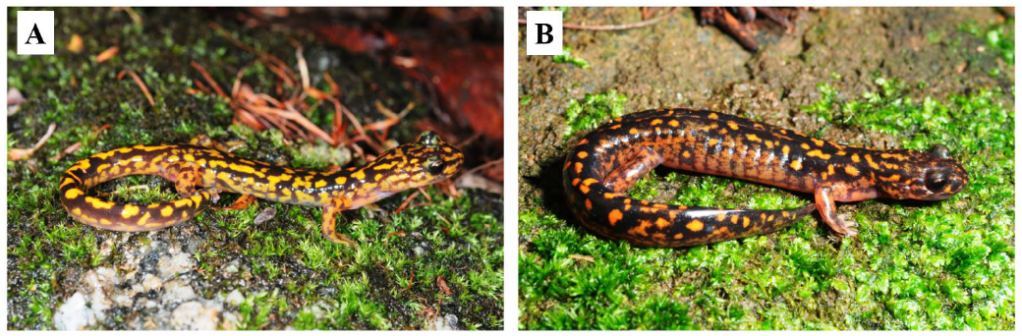
通过多项合作包括描述,发布的新出版物 Onychodactylus sillanus 即新罗爪鲵!

即新罗爪鲵(Onychodactylus sillanus) 的一生

尚未被学界正式描述的物种往往都难以得到有效的保护,不论它们的受威胁等级有多高。尽管韩国境内的栖息地质量近年来持续衰退,但其国内两栖动物分类学和保护生物学的研究仍处于较滞后的状态。

例如,尽管已有研究表明爪鲵属Onychodactylus在朝鲜半岛最南端存在一个独立演化支系,与其姐妹种韩国爪鲵Onychodactylus koreanus分化时间已达6.82百万年,且该独立演化支系受到严重的人为活动干扰威胁,但至今该支系依旧未得到妥善的法律保护。该研究结合形态、分子和模型模拟,确定了韩国爪鲵属这一独立演化支系的分类地位,将其描述为一新种,即新罗爪鲵Onychodactylus sillanus sp. nov. 

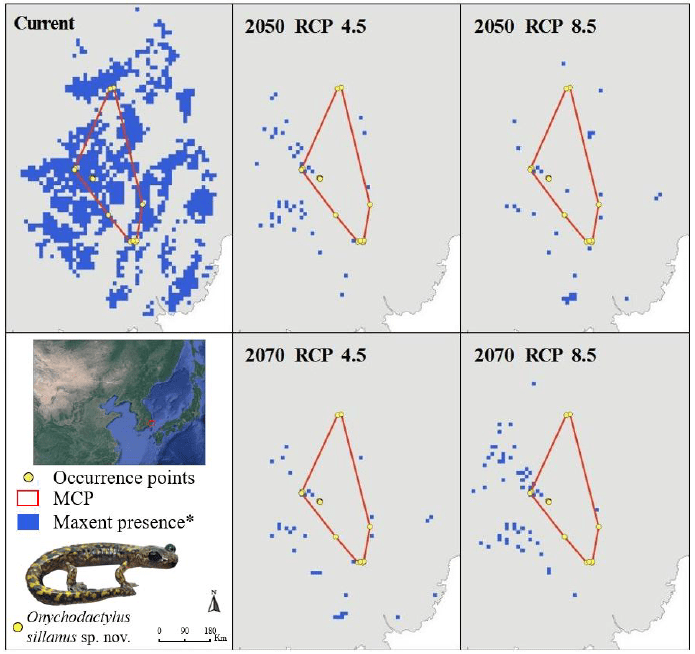
即新罗爪鲵(Onychodactylus sillanus) 的分布范围、适宜生境和系统发育关系。

此外,依据IUCN标准和不同温室气体的典型浓度路径(Representative Concentration Pathways, RCPs),研究评估了新种的生存威胁、栖息地破坏程度和灭绝可能性。依据多个不同的气候变化模型,研究结果预测在新种未来三代的时间内其适宜栖息地将会缩减87.6%–97.3%,而依据IUCN标准A3,这样的种群变化趋势应被评为极危CR。研究结果可以为将来开展针对性保护行动提供理论支撑

未来气候变化对即新罗爪鲵(Onychodactylus sillanus) 适宜生境的潜在影响

Borzée A., Shin Y., Poyarkov N. A., Jeon J. Y., Baek H. J., Lee C. H., An J., Hong Y. J., Min M-S. (2022).  Dwindling in the mountains: description of a critically endangered and microendemic Onychodactylus species (Amphibia, Hynobiidae) from the Korean Peninsula. Zoological Research. 43(5):750-755. DOI: 10.24272/j.issn.2095-8137.2022.048

Attendance to the Graduate Summer Course in Bioacoustics (Denmark)

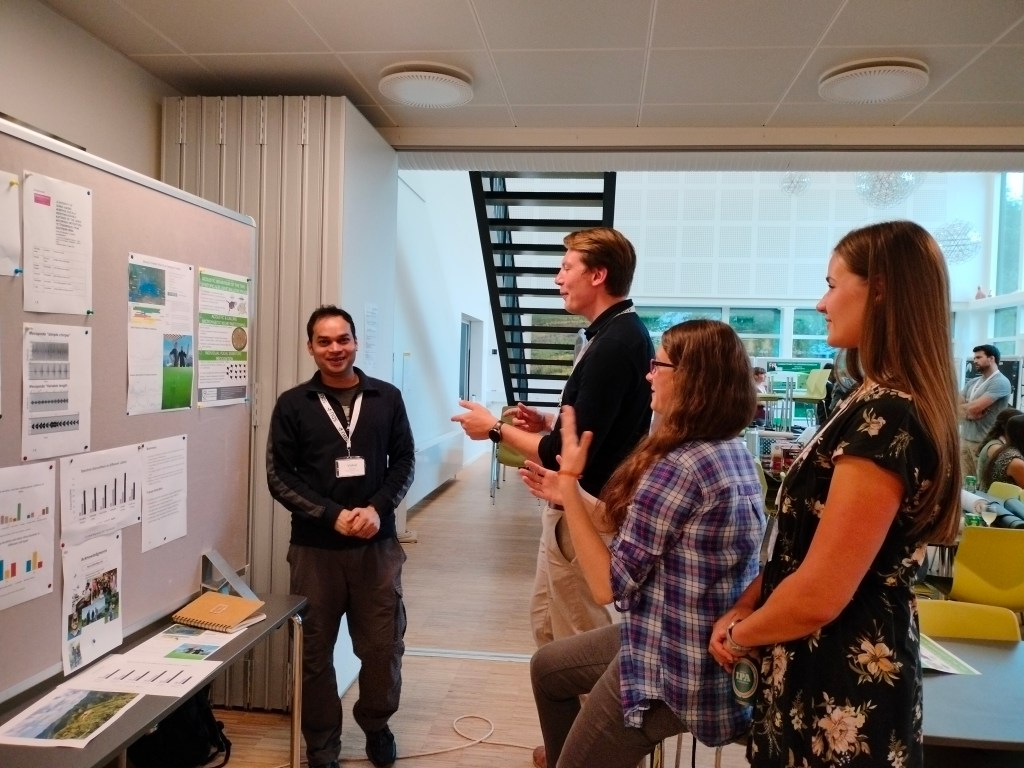
Vishal Kumar Prasad presented a poster/graphical summary about his recent publication “Vocal behaviour of Balloon frogs” at the Southern Denmark University in Odense, Denmark on 7 August 2022. The poster presentation was one of the programs of the biennial international Ph.D. course on bioacoustics he is participating in.

Vishal Kumar Prasad with  Prof. Jakob Christensen-Dalsgaard (course director) and other participants. 

From the wild to our plates: crypticity in the northeast Asian trade of brown frogs – a muti-tool approach

New lab paper on the trade of Brown Frogs (Rana sp.) in northeast Asia, including the delineation of cryptic species, and morphological tools for species identification to act against the trade of mis-identified individuals.

The trade of amphibians increases the risk of invasions across the world, and northeast Asia. To understand the trade in the area, we developed an accurate species assignment and workflow guiding a broad-scale species identification and resolving the trade pathways. We tested our workflow on unidentified cryptic brown frogs imported into the Republic of Korea.

Comparative species delimitations determining the OTUs on a calibrated timetree and matching comparative morphometry. (A) Comparative species delimitation based on the 16S rRNA gene barcode marker for 171 individuals of Rana originated from the trade determined by Automatic Barcode Gap (ABGD), General Mixed Yule Coalescent (GMYC) and Bayesian-Poisson Tree Process (bPTP) schemes. The partitions of the OTUs for each scheme is indicated below the tree nodes with specific colour gradients. The principal component analysis (PCA) for the 15 morphometric variables analysed for 208 individuals originating from the trade and a museum collection adjusted for (B) polyphyletic clades, and (C) parapatric clades (statistical analyses in Supplementary Tables S7 and S9). Each Rana clade is colour coded, matching with the colour of its range on the distributional map. The placement of R. uenoi in clade 2 was adapted from the Bayesian Inference tree and marked in the time tree (dashed box). 

The workflow combined morphometry, phylogenetic trait, species delimitation modelling and phylogeography, and successfully identified three non-native species imported in Korea: Rana chensinensis, Rana amurensis and Rana kukunoris out of 171 specimens bought from the trade.

Using a machine-learning approach with Bayes Factor Delimitation method to evaluate the taxonomy models from four commonly used species delimitation tools (BLAST, ABGD, sGMYC and bPTP), and isolated 12 operational taxonomic units (OTUs) from the 171 individuals. We then combined the information from the 12 OTUs and combined it into a 16S phylogeny including traded and control specimens (n = 230).

The model-based OTUs and phylogeny revealed the widespread and likely wild-harvested origins of traded Rana individuals, cycled through farm in China to be integrated in the legal trade. Apart from the genetic, our morphometry also indicates extremely high phenotype crypticity between the endemic Korean species, especially R. huanrenensis and those brown frogs from the trade.

 However, the trait evolution results also highlight a pattern of independent evolution of toe webbings in Rana for the last 12.0 Mya, most likely a useful key-trait for Rana species identification across northeast Asian. With the workflow for broad-scale species identification developed herein, we urge the development of trade monitoring and legislation on Rana species in northeast Asia.

Phenotypic evolution of toe webbing in selected northeast Asian Rana since the Miocene. The ancestral range reconstruction from the calibrated species tree including 181 individuals includes six taxa from northeast Asian Rana (385 bp of 16S rRNA). The colour coding in the trait value indicates the rate of evolution in phenotypic trait related to the angle made by the webbing between webbed toes I and II (WTA). The species the closest to the ancestral character is Rana coreana and the derived character rose in R. kukunoris. The earliest and the most recent transition times for WTA character to evolve from the ancestral to the youngest clades mark on the tree time with straight dotted and solid arrows, respectively.

Othman S. N., Shin Y., Kim H.-T., Chuang M.-F., Bae Y., Hoti J., Zhang Y., Jang Y. & Borzée A. (2022).Evaluating the efficiency of popular species identification analytical methods, and integrative workflow using morphometry and barcoding bioinformatics for taxonomy and origin of traded cryptic brown frogs.Global Ecology and Conservation. 38:e02253. DOI: 10.1016/j.gecco.2022.e02253