I’m leading the Laboratory of Animal Behaviour and Conservation at Nanjing Forestry University, where we focus on a broad range of species. Projects were so far focused on the behavioural ecology and conservation of amphibian species in East Asia, but this is changing and you are welcome to inquire, maintaining a focus on North East Asia.
Othman S. N., Shin Y., Kim H.-T., Chuang M.-F., Bae Y., Hoti J., Zhang Y., Jang Y. & Borzée A.(2022).Evaluating the efficiency of popular species identification analytical methods, and integrative workflow using morphometry and barcoding bioinformatics for taxonomy and origin of traded cryptic brown frogs.Global Ecology and Conservation. 38:e02253. DOI: 10.1016/j.gecco.2022.e02253
Borzée A., Shin Y., Poyarkov N. A., Jeon J. Y., Baek H. J., Lee C. H., An J., Hong Y. J., Min M-S. (2022). Dwindling in the mountains: description of a critically endangered and microendemic Onychodactylus species (Amphibia, Hynobiidae) from the Korean Peninsula. Zoological Research. 43(5):750-755. DOI: 10.24272/j.issn.2095-8137.2022.048
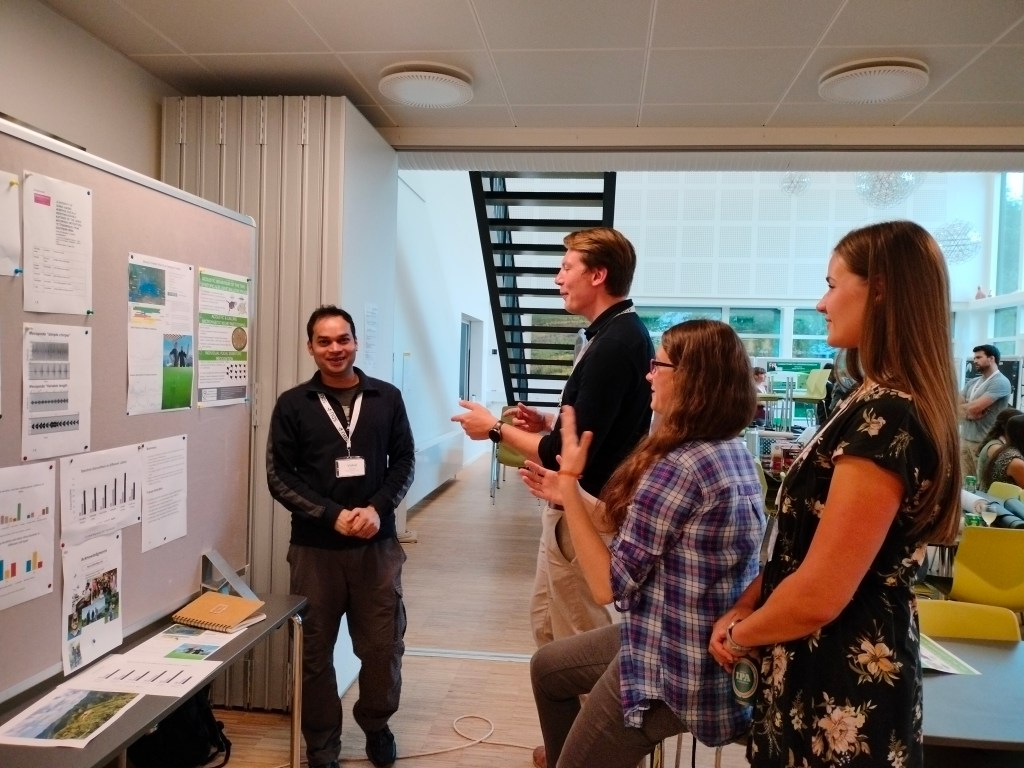
Vishal Kumar Prasad presented a poster/graphical summary about his recent publication “Vocal behaviour of Balloon frogs” at the Southern Denmark University in Odense, Denmark on 7 August 2022. The poster presentation was one of the programs of the biennial international Ph.D. course on bioacoustics he is participating in.
Vishal Kumar Prasad with Prof. Jakob Christensen-Dalsgaard (course director) and other participants.
New lab paper on the trade of Brown Frogs (Rana sp.) in northeast Asia, including the delineation of cryptic species, and morphological tools for species identification to act against the trade of mis-identified individuals.
The trade of amphibians increases the risk of invasions across the world, and northeast Asia. To understand the trade in the area, we developed an accurate species assignment and workflow guiding a broad-scale species identification and resolving the trade pathways. We tested our workflow on unidentified cryptic brown frogs imported into the Republic of Korea.
Comparative species delimitations determining the OTUs on a calibrated timetree and matching comparative morphometry. (A) Comparative species delimitation based on the 16S rRNA gene barcode marker for 171 individuals of Rana originated from the trade determined by Automatic Barcode Gap (ABGD), General Mixed Yule Coalescent (GMYC) and Bayesian-Poisson Tree Process (bPTP) schemes. The partitions of the OTUs for each scheme is indicated below the tree nodes with specific colour gradients. The principal component analysis (PCA) for the 15 morphometric variables analysed for 208 individuals originating from the trade and a museum collection adjusted for (B) polyphyletic clades, and (C) parapatric clades (statistical analyses in Supplementary Tables S7 and S9). Each Rana clade is colour coded, matching with the colour of its range on the distributional map. The placement of R. uenoi in clade 2 was adapted from the Bayesian Inference tree and marked in the time tree (dashed box).
The workflow combined morphometry, phylogenetic trait, species delimitation modelling and phylogeography, and successfully identified three non-native species imported in Korea: Rana chensinensis, Rana amurensis and Rana kukunoris out of 171 specimens bought from the trade.
Using a machine-learning approach with Bayes Factor Delimitation method to evaluate the taxonomy models from four commonly used species delimitation tools (BLAST, ABGD, sGMYC and bPTP), and isolated 12 operational taxonomic units (OTUs) from the 171 individuals. We then combined the information from the 12 OTUs and combined it into a 16S phylogeny including traded and control specimens (n = 230).
The model-based OTUs and phylogeny revealed the widespread and likely wild-harvested origins of traded Rana individuals, cycled through farm in China to be integrated in the legal trade. Apart from the genetic, our morphometry also indicates extremely high phenotype crypticity between the endemic Korean species, especially R. huanrenensis and those brown frogs from the trade.
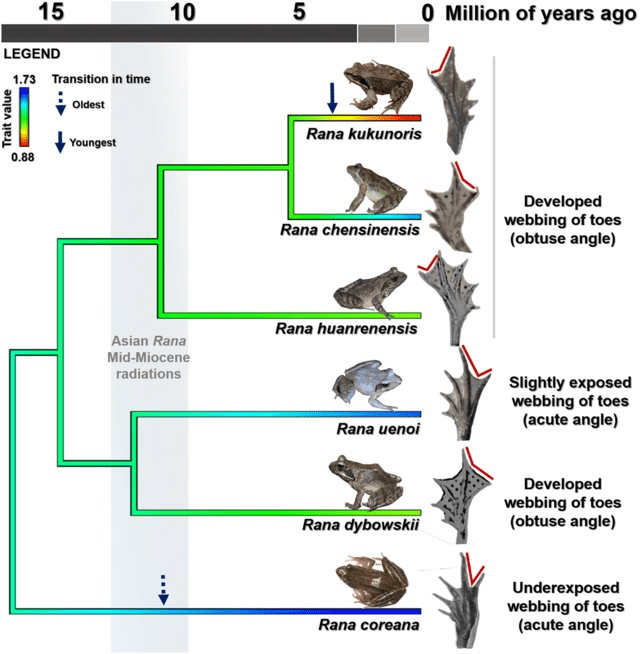
However, the trait evolution results also highlight a pattern of independent evolution of toe webbings in Rana for the last 12.0 Mya, most likely a useful key-trait for Rana species identification across northeast Asian. With the workflow for broad-scale species identification developed herein, we urge the development of trade monitoring and legislation on Rana species in northeast Asia.
Phenotypic evolution of toe webbing in selected northeast Asian Rana since the Miocene. The ancestral range reconstruction from the calibrated species tree including 181 individuals includes six taxa from northeast Asian Rana (385 bp of 16S rRNA). The colour coding in the trait value indicates the rate of evolution in phenotypic trait related to the angle made by the webbing between webbed toes I and II (WTA). The species the closest to the ancestral character is Rana coreana and the derived character rose in R. kukunoris. The earliest and the most recent transition times for WTA character to evolve from the ancestral to the youngest clades mark on the tree time with straight dotted and solid arrows, respectively.
Othman S. N., Shin Y., Kim H.-T., Chuang M.-F., Bae Y., Hoti J., Zhang Y., Jang Y. & Borzée A.(2022).Evaluating the efficiency of popular species identification analytical methods, and integrative workflow using morphometry and barcoding bioinformatics for taxonomy and origin of traded cryptic brown frogs.Global Ecology and Conservation. 38:e02253. DOI: 10.1016/j.gecco.2022.e02253
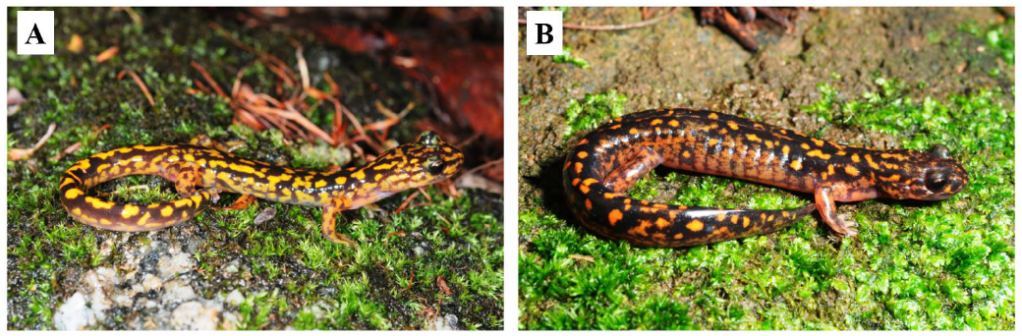
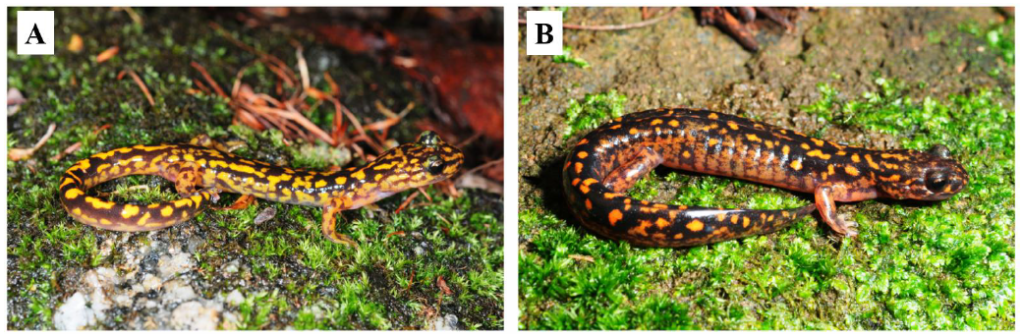
New publicationthrough multiple collaborations including the description of Onychodactylus sillanus Yangsan Clawed Salamander (양산꼬리치레도롱뇽)!
Onychodactylus sillanus in life. Legends in the publication.
For wildlife to be protected, it must first be known, as species that are not yet formally described are not the target of conservation attention, independently of threat levels. While habitat degradation has consistently increased across the last decades in the Republic of Korea, taxonomic and conservation efforts are lagging.
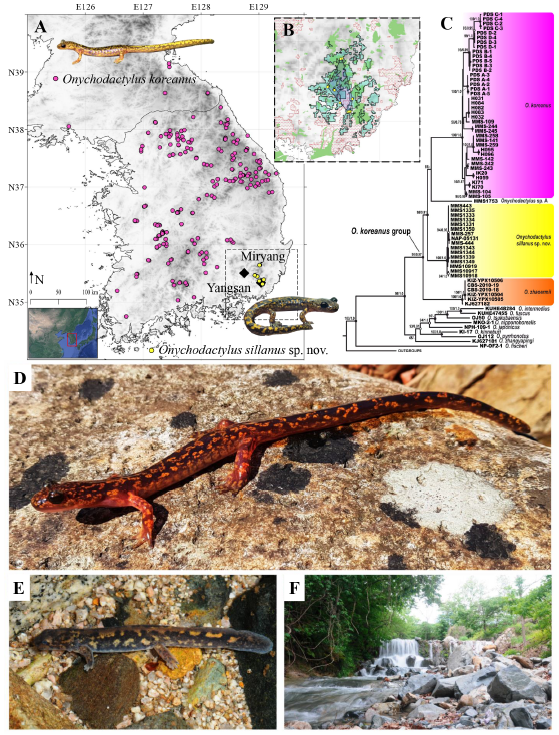
For instance, a clade of Onychodactylus clawed salamanders from the extreme southeast of the Korean Peninsula is known to have diverged circa 6.82 million years ago from its sister species O. koreanus, and despite the candidate species status of this lineage, its extremely restricted range is under intense anthropogenic pressure. Here, through the use of genetics, morphometrics and landscape modelling, we confirmed the species status of the southeast Korean Onychodactylus population and formally describe it as Onychodactylus sillanus (Yangsan Clawed Salamander; 양산꼬리치레도롱뇽).
Range, suitable habitat, and phylogenetic relationships of Onychodactylus sillanus. Legends in the publication.
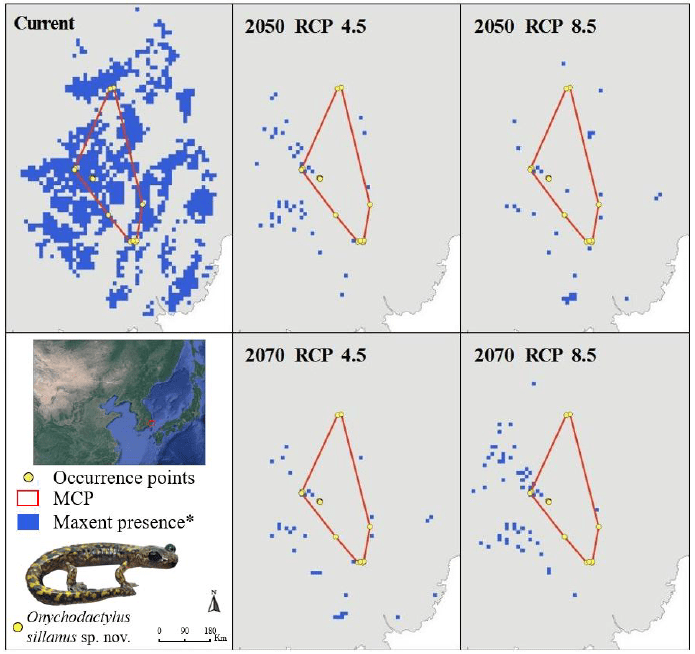
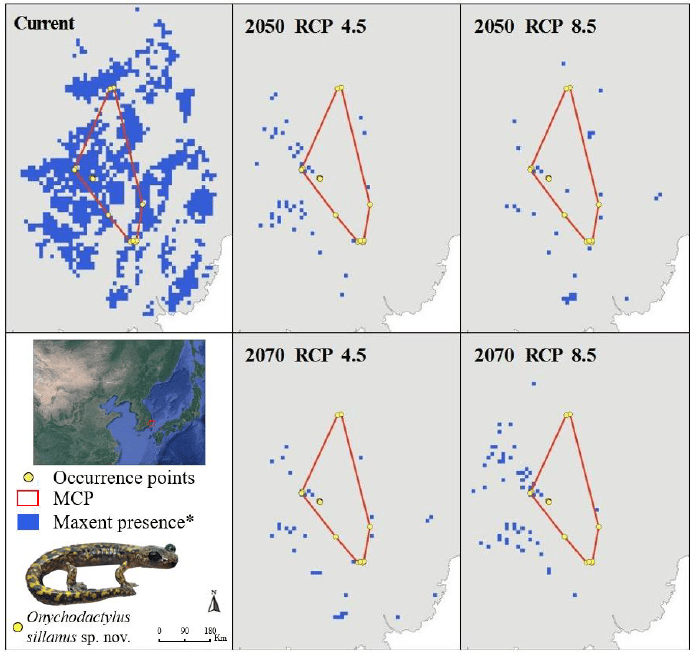
We then proceed to determine threats, habitat loss and risk of extinction based on climatic models under different Representative Concentration Pathways and following the IUCN Red List categories and criteria. We highlight a decrease in the extent of occurrence between 87.6% and 97.3 % within the next three generations based on several climate change scenarios, a decline high enough for the species to be listed as Critically Endangered based on the category A3 of the IUCN Red List of species. Our results will enable the development of protection programs and legitimise citizen activities protecting the population. A conservation action plan is a priority to coordinate the activities linked to the protection of the species.
Potential impacts of future climate change on the suitable habitat of Onychodactylus sillanus sp. nov. Legends in the publication.
Borzée A., Shin Y., Poyarkov N. A., Jeon J. Y., Baek H. J., Lee C. H., An J., Hong Y. J., Min M-S. (2022). Dwindling in the mountains: description of a critically endangered and microendemic Onychodactylus species (Amphibia, Hynobiidae) from the Korean Peninsula. Zoological Research. 43(5):750-755. DOI: 10.24272/j.issn.2095-8137.2022.048




 Laboratory of Animal Behaviour and Conservation