Read the full paper: Othman SN and Borzée A. 2026. Heredity 135: 497–524. https://doi.org/10.1038/s41437-026-00856-3
Amphibians of Northeast Asia provide a valuable model system for studying evolution. The region extends from subtropical China to the cold Russian Far East, covering northeastern China, Mongolia, the Korean Peninsula and Japan. Across this enormous environmental gradient, how have amphibians responded to changing mountains, rivers, climates and coastlines?
In our new synthesised review published in Heredity, we reconstructed the history across northeast Asia, from the Paleogene (62 of millions of years ago), to the to the present period of intensive human influence. We screened more than 17,800 records and retained 39 studies published between 1998 and 2025. We combined their divergence-time estimates with time-calibrated evolutionary trees for 42 East Asian species, reconstructed using mitochondrial sequences and genome-wide genetic variants. We also examined body size, maximum elevation and latitudinal range to explore how ecological traits changed through time.
Our synthesis identified four recurring evolutionary drivers.
First, ancient geological processes, including the formation of the Qinghai-Tibetan Plateau, reshaped climates, mountains and river systems across Asia. These changes created new habitats and geographic barriers that promoted population isolation and divergence.
Second, climatic variation across the region’s broad latitudinal gradient encouraged adaptation to contrasting environments. True frogs of the family Ranidae displayed particularly broad ecological traits and comparatively dynamic diversification across elevations and latitudes (Fig. 1).
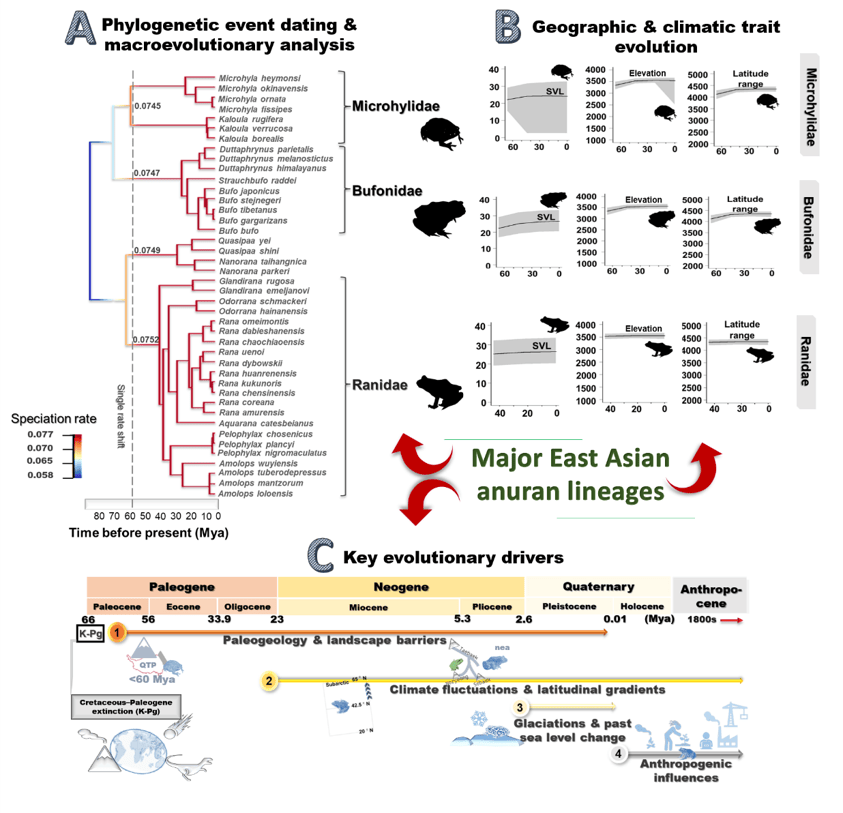
Third, ice ages and changing sea levels repeatedly separated and reconnected some amphibian populations. During periods of low sea level, parts of the Yellow Sea floor were exposed, creating land connections between mainland China and the Korean Peninsula. Amphibians could then move between these areas. When the sea covered these connections again, the populations became isolated. After the ice ages, some populations expanded and came into contact again, sometimes resulting in hybridisation, as seen in Pelophylax species.
Fourth, human activities are reshaping amphibian evolutionary patterns that developed over millions of years. The movement and release of Bufo toads for food, medicine or the pet trade can introduce different genetic lineages into new areas. Meanwhile, changes to rice-paddy habitats have promoted contact and hybridisation between Dryophytes japonicus and D. suweonensis treefrogs.
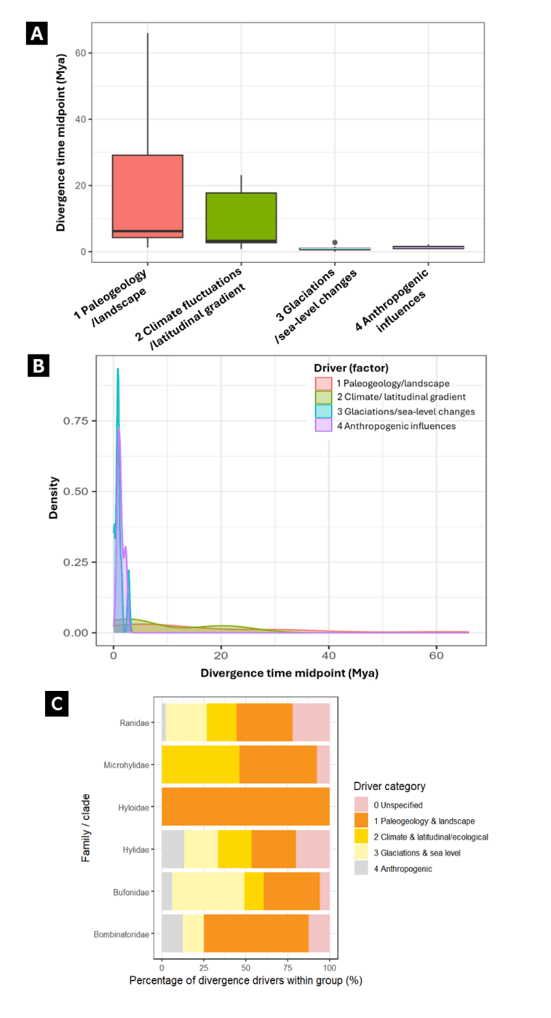
Finally, by placing published divergence estimates within a single timeline, our review shows how the importance of different evolutionary drivers changed through time. Paleogeology and climate were associated with older divergence events, whereas glaciations, sea-level changes and human influences became important more recently, with the relative contributions of these drivers differing among amphibian groups (Fig. 2). Our findings provide a reference for future research and conservation across Northeast Asia.