Blog

An integrative synthesis to global amphibian conservation priorities

New publication (PDF here*) in collaboration with Sky Button from Washington State University published in Global Change Biology: An integrative synthesis to global amphibian conservation priorities.

Human activities are driving many species to the brink of extinction, and the current distribution of protected areas only weakly alleviates pressure on threatened species. This discrepancy reflects the presence of protected areas on lands available instead of the ecological, evolutionary, or conservation values of species present. Habitat loss consequently continues to impact threatened species, as illustrated by geographic patterns of biodiversity loss for amphibians.

Given the need to better align the boundaries of protected areas with at-risk biodiversity, we assessed the importance of various factors for identifying global and biome-level conservation priority areas, specifically for amphibians. We identified, mapped, and ranked areas of critical conservation importance for all amphibian species on earth using a new integrative tool that scores the urgency of conserving each species and location based on a combination of species characteristics and ecoregion-level human impacts. Our integrative approach is novel in that it accounts for likely threats to Data Deficient species, considers the irreplaceability of unique species that are phylogenetically isolated, and addresses the localized conservation implications of species endemicity and projected future human impacts to an ecoregion.

For comparison, we also mapped and ranked amphibian biodiversity using species richness and an Evolutionarily Distinct and Globally Endangered (EDGE) score proxy. Our integrative approach predicted key regions for amphibian conservation that were not apparent when using a simple species richness or EDGE score proxy-based approach.
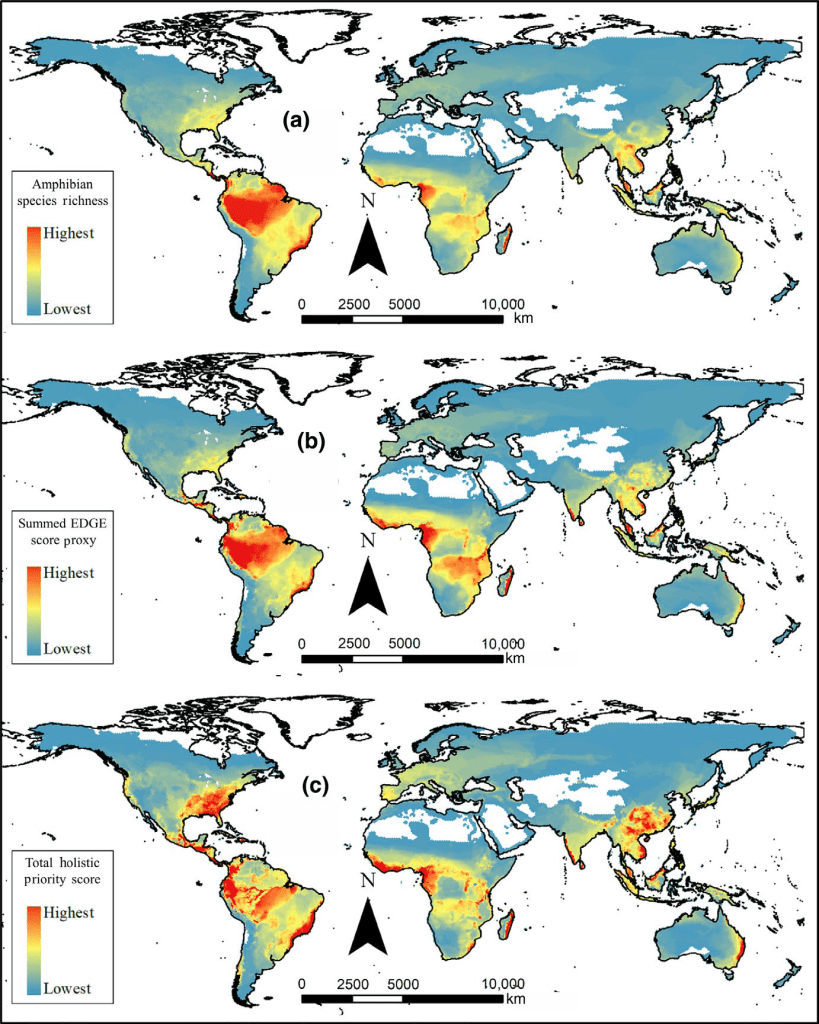
Relative conservation priority scores for amphibians using species richness (a), EDGE score proxy
(b), and the integrative approach (c). We calculated priority scores for each approach by summing the scores (or number) of species overlapping each grid cell. The spatial distribution of high-scoring pixels differed considerably among the three approaches, with the integrative and EDGE score proxy approaches suggesting higher conservation priorities in the Paleotropics than the species richness approach

Furthermore, by scaling conservation priority scores relative to biome, we identified several temperate and xeric regions of crucial yet overlooked conservation importance for amphibians. Until global amphibian diversity is thoroughly catalogued, we recommend using our integrative scoring approach to set geographic priorities for amphibian habitat protection, while acknowledging that this approach may be complemented by others (e.g., EDGE scores). Our study provides an avenue for avoiding common pitfalls of more simplistic species richness-based approaches for conservation planning, and can be used to improve the future design of protected areas.
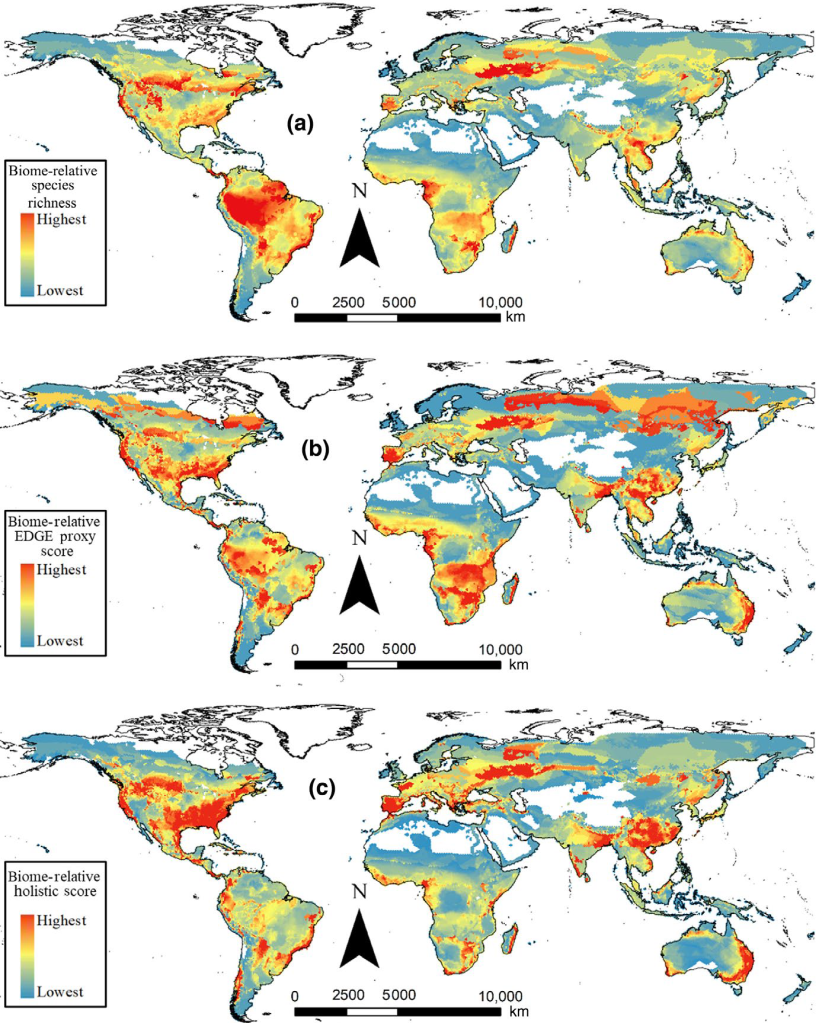
Conservation priority scores for each pixel relative to other pixels within the same biome, for the species richness (a), EDGE score proxy (b), and integrative scoring approach (c). We calculated global-scale priority scores for each approach by summing the scores (or number) of species overlapping each grid cell. We scaled these scores to biome level by dividing the score of each pixel by the score of the highest-scoring pixel within the same biome. Our biome-scale adjustments highlight several key areas for conserving temperate and xeric-adapted amphibians, which are not visually apparent in our global-scale maps.

This new approach is a game changer for amphibian conservation in northeast Asia, as it highlight areas that are usually ignored from conservation priotities.

Details of conservation priorities for amphibians in northeast Asia.

*Clicking on this link is considered as a private request to the authors
An update on amphibians of DPR Korea!

New publication updating the knowledge on all amphibian species of DPR Korea! A large piece of work, including 21 co-authors, and all amphibian experts of DPR Korea! (Official link here).

Determining the range, status, ecology and behaviour of species from areas where surveys and samplings are uncommon or difficult to conduct is a challenge, such as in the Democratic People’s Republic of Korea (DPR Korea). Here, we used genetic samples, field surveys, call recordings, photographic identification and a literature review to estimate the presence, range and status of amphibians in the DPR Korea.

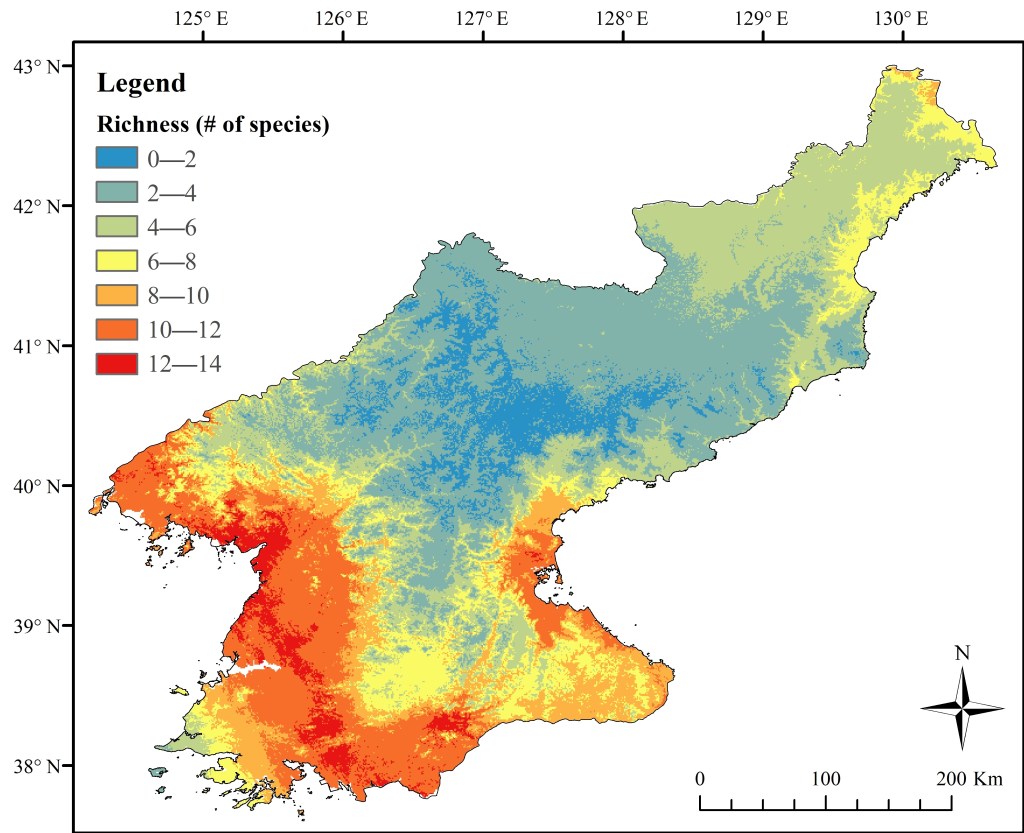
Amphibian species richness for all amphibian species recorded in DPR Korea. This map combines MaxEnt models using a sum of presence probabilities. See full text for details.

From our combined results and based on the IUCN Red List categories and criteria, we were able to estimate the national threat levels for most species. Our results demonstrated the presence of 18 native species and the suspected presence of Karsenia koreana and two Onychodactylus species. We reported the first record for Rana uenoi in the vicinity of Pyongyang using molecular tools and similarly confirmed the presence of Dryophytes japonicus at the same location.

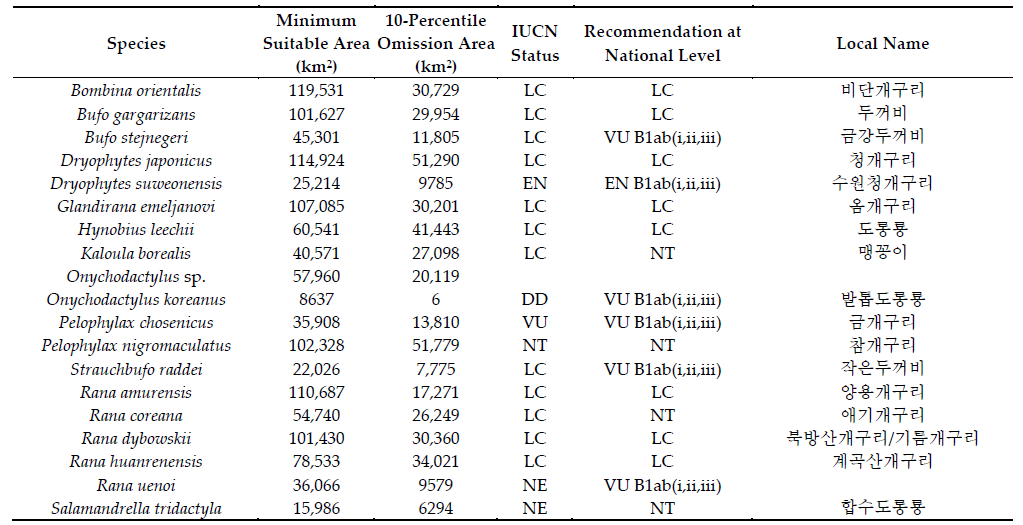
Description of presence models used for each species in DPR Korea. The surface area in km2 provided matches with the 10-percentile training and the 95% presence used in models. IUCN threat levels as of February 2019 (www.iucnredlist.org). See full text for details.

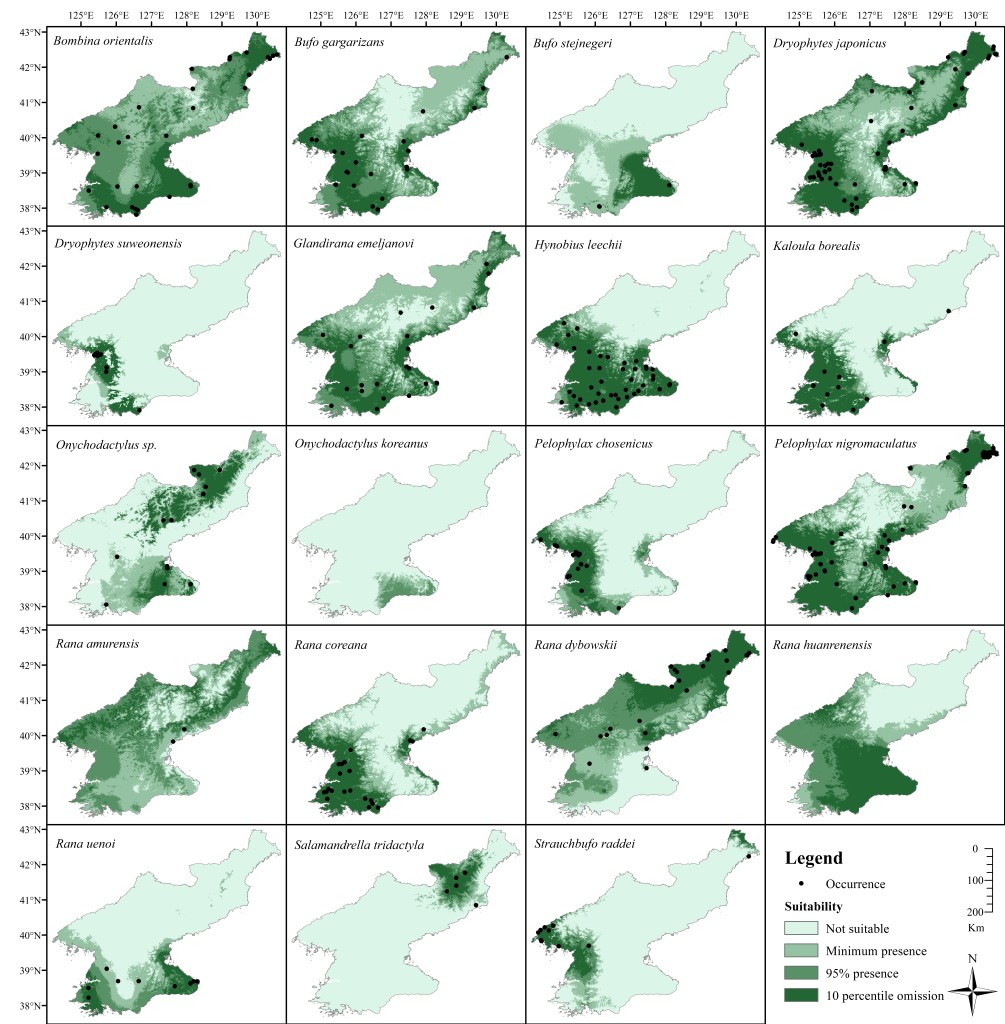
Based on distribution and modelling, we can expect the contact zone between species within the Rana and Onychodactylus genera to be located along the Changbai Massif, a mountain range that marks a shift in ecoregions and acts as a barrier to dispersion.

The species richness was higher in the lowlands and at lower latitudes, with such areas populated by up to 11 species, while more northern regions were characterised by species richness of about half of that value. The combination of ecological models and known threats resulted in the recommendation of ten species as threatened at the national level following the IUCN Red List categories and criteria. This high number of threatened species was anticipated based on the high threat level to amphibians in bordering nations and globally.

While the ecology of species in the DPR Korea is still understudied, we argue that species relying on agricultural wetlands such as rice paddies are not under imminent threat due to the enduring presence of extensive agricultural landscapes with low rates of chemical use and mechanisation. The maintenance of such landscapes is a clear benefit to amphibian species, in contrast to more industrialised agricultural landscapes in neighbouring nations. In comparison, the status of species dependent on forested habitats is unclear and threat levels are likely to be higher because of deforestation, as in neighbouring nations.

MaxEnt models for all amphibian species recorded in DPR Korea. See full text for details.

Impact of the Miocene orogenesis on Kaloula radiation

New collaborative research paper in Integrative Zoology led by Siti N. Othman from Ewha Womans University!

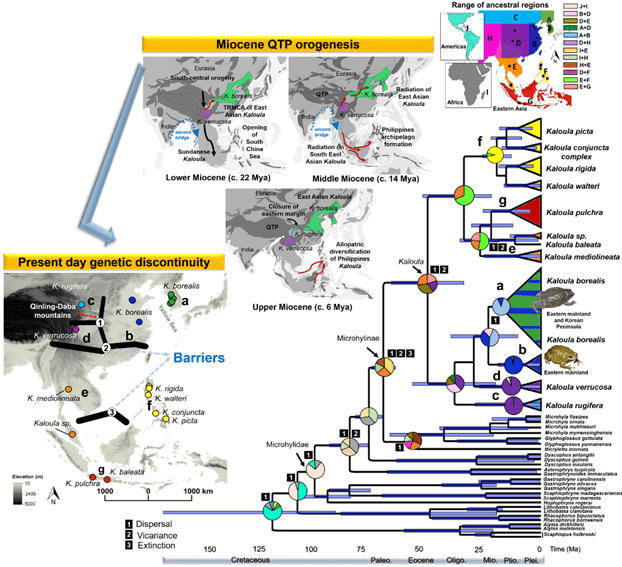
The phylogeography of the Kaloula genus is still poorly understood. One of the difficulties is the absence of fossils to corroborate molecular dating estimates. Here, we examined the mitochondrial structure of Kaloula spp. in East Asia and focused on the impact of glaciations and past geological events on the northernmost species: Kaloula borealis.

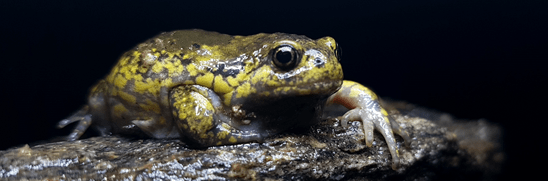
Kaloula borealis from the Republic of Korea

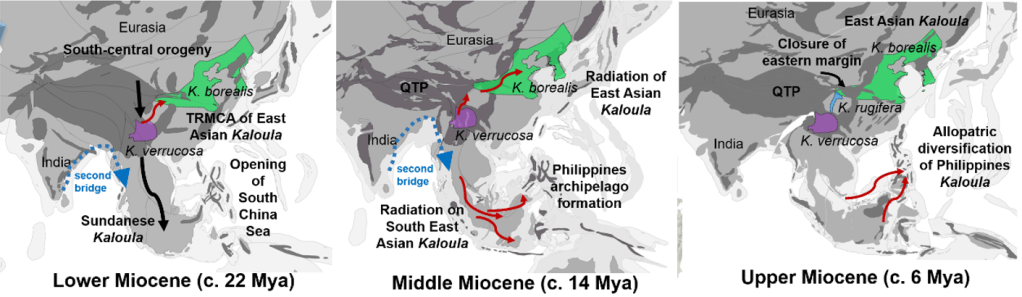
We determined the phylogenetic relationships, molecular dating and genetic connectivity assessments within the genus from 1,211 bp of concatenated mitochondrial 12S and 16S. The relaxed clock analyses reveal the emergence of Kaloula spp. common ancestor in East and South East Asia between the Eocene and Oligocene, c. 38.47 Ma (24.69 – 53.65). The genetic diversification of lineages then increased on the East Asian Mainland during the Lower Miocene, c. 20.10 Ma (8.73 – 30.65), most likely originating from the vicariance and radiation triggered by the orogeny of the Qinghai-Tibetan Plateau. Later, the dispersal towards the North East Asian Mainland during the Upper Miocene drove the population diversification of K. borealis c. 9.01 Ma (3.66 – 15.29). Finally, the central mainland population became isolated following orogenesis events and diverged into K. rugifera during the Pliocene, c. 3.06 Ma (0.02 – 10.90).

Miocene Qinghai-Tibetan Plateau orogenesis and related dynamic of Kaloula populations

The combination of population genetic and barrier analyses revealed a significant genetic isolation between populations of Kaloula spp. matching with the massive Qinling-Daba Mountain chain located in south-central China. Finally, we highlight a young divergence within the Eastern Mainland population of K. borealis, possibly attributed to refugia in South Eastern China from which populations later expanded.

Direct download here.

1970년부터 2020년까지 남한 내 독사교상에 대한 고찰

이화여자대학교의 장이권 교수님과 공동으로 수행한 연구가 출판되었습니다! 논문은 여기에서 보실 수 있습니다. Post in English here.

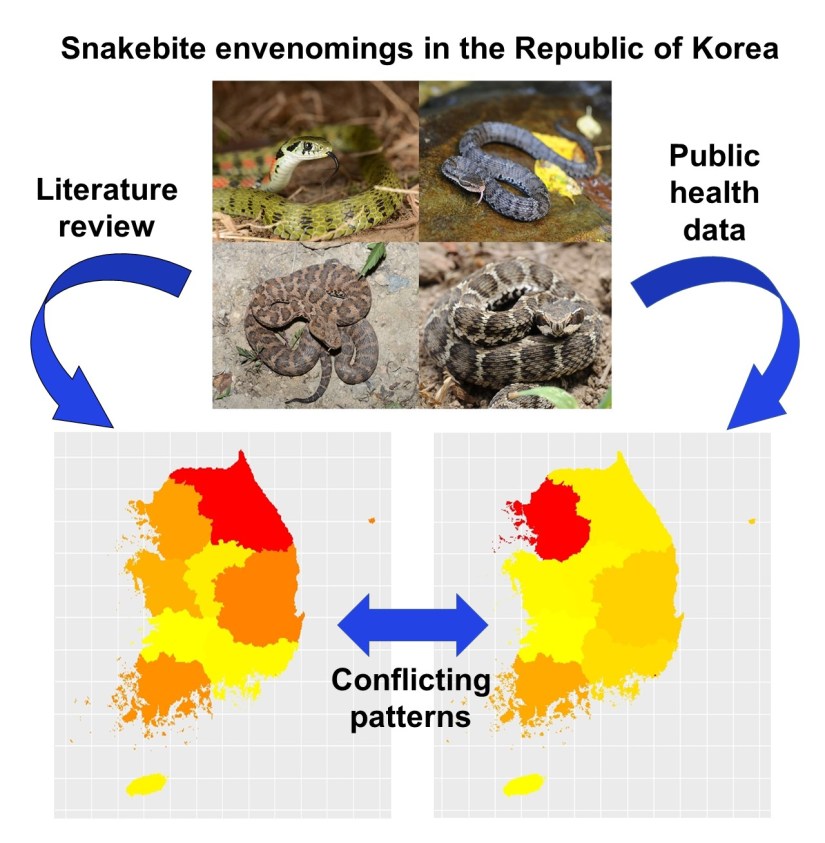
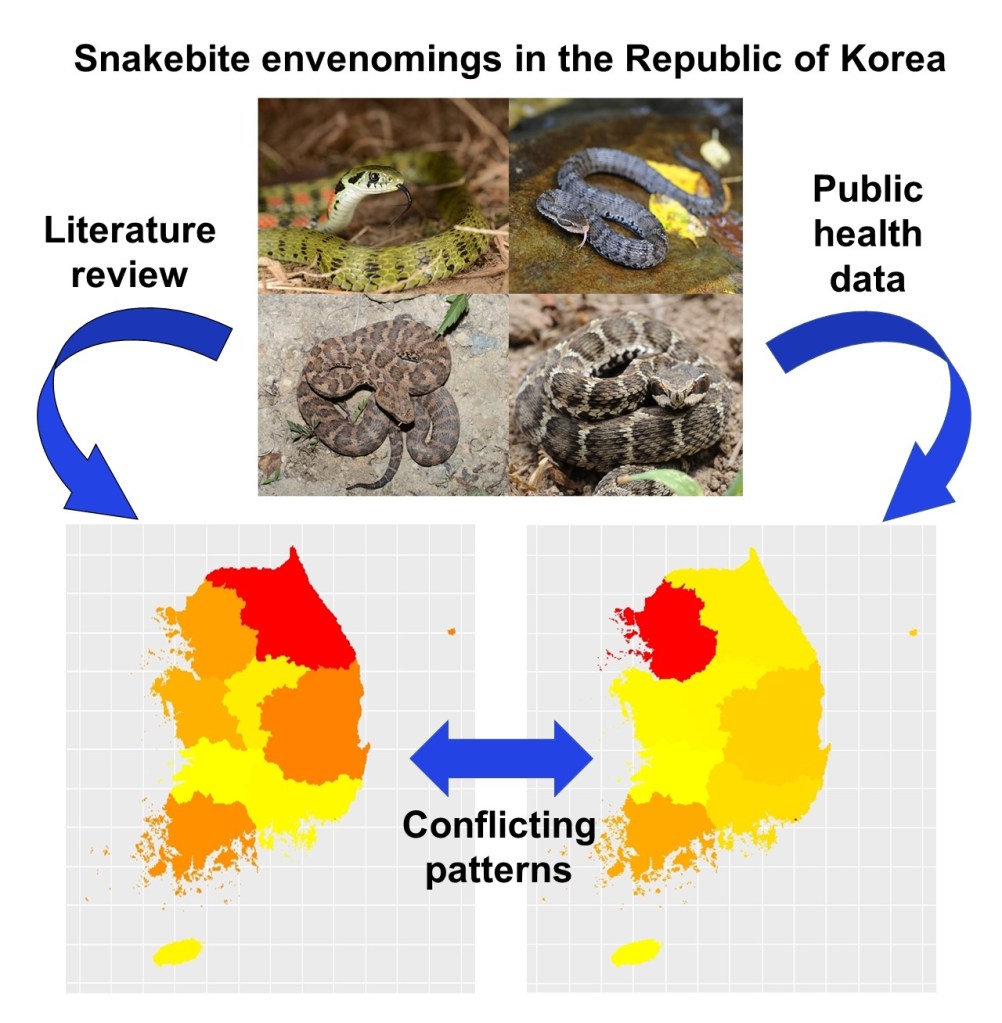
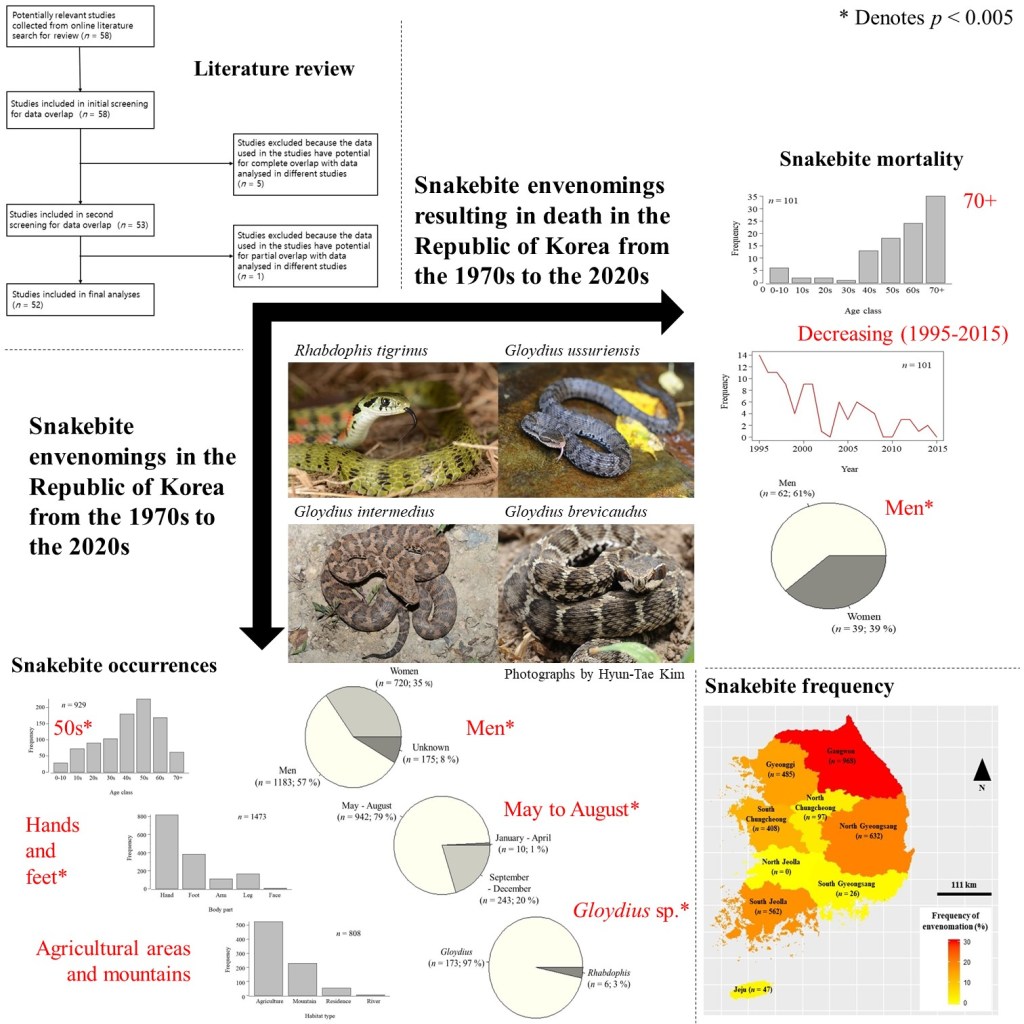
요약된 연구 결과. 문헌 자료와 건강보험 데이터로부터 독사 교상에 대한 상반된 패턴이 유추되었음을 볼 수 있다. 사진: 김현태 선생님 제공.

1970 년부터 2020년까지 남한 내 독사 교상 (snakebite envenomings)의 패턴을 리뷰하고 분석한 저희 논문이 독성학 저널 Toxicon에 게재되었습니다. 남한의 육상 뱀 중 살모사(Gloydius brevicaudus), 까치살모사(G. intermedius), 쇠살모사(G. ussuriensis), 그리고 유혈목이(Rhabdophis tigrinus)가 독사로 알려져 있고 그간 우리나라에서 독사 교상에 대한 사례 연구, 임상적 고찰 등의 연구가 출간되긴 했지만, 독사 교상의 전국적인 패턴은 잘 알려지지 않은 상황입니다.


따라서, 이번 연구에서는 1970년부터 2020년까지 우리나라에서 출간된 연구결과들을 종합하여 데이터를 추출한 후 독사 교상의 전국적인 패턴을 유추하고자 했고, 한편으로는 건강보험심사평가원의 데이터를 사용하여 문헌자료에서 추출된 데이터와 비교했습니다.

결과를 요약하자면, 문헌 및 건강보험 데이터에서 유추된 연간 독사교상 발생 건수는 실제 발생하는 건수에 훨씬 못 미칠 것으로 예상되며, 또한 문헌자료로부터 유추된 패턴과 건강보험 데이터로부터 유추된 패턴 사이에 상당한 충돌이 있는 것을 확인할 수 있었습니다. 이런 문제를 해결하기 위해 추후에 보다 포괄적인 연구가 필요할 것으로 생각됩니다.

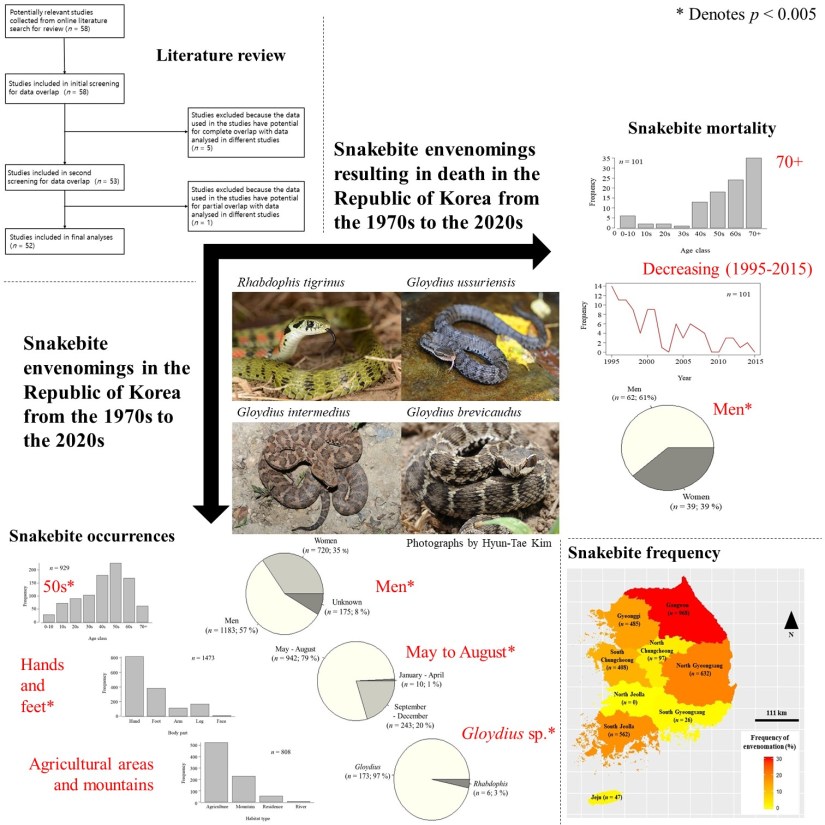
문헌 자료로부터 수행한 분석의 개요. 사진: 김현태 선생님 제공.

A review of snakebite envenomings in the Republic of Korea from the 1970s to the 2020s

New publication in collaboration with Prof. Yikweon Jang from Ewha Womans University published in Toxicon! The full paper is accessible here. 여기에서 한국어로 보실 수 있습니다.

Summary of the main results, highlighting the conflicting patterns of envenomings between the literature and public health data Photographs courtesy of Mr. Kim Hyun-Tae

In our new paper published in the journal Toxicon, we reviewed the patterns of snakebite envenomings in the Republic of Korea (ROK), covering almost 50 years of compiled data.


There are four species of medically significant terrestrial venomous snakes in the ROK: Gloydius brevicaudus (Short-tailed pitviper; 살모사*), G. intermedius (Rockpitviper; 까치살모사*), G. ussuriensis (Ussuri pitviper; 쇠살모사*), and Rhabdophis tigrinus (Tiger keelback; 유혈목이*). However, information on the broad patterns of snakebite envenomings (e.g., geographical, demographic) in the ROK are either partially documented and/or poorly represented in the global-scale research on snakebite envenomings.

So, we compiled available literature and also accessed public health database to summarize and synthesize the broad patterns of snakebite envenomings in the ROK. Our results show that the annual number of snakebite cases based on the literature and public health database (which are in turn based on hospital admissions) are most likely an underestimation of the true number of annual snakebite occurrences. Also, our results highlight the conflicting patterns of snakebite envenomings between the literature and public health database.


Our study filled in some gaps in our knowledge of snakebite envenomings in the ROK, but opened up some new ones. More comprehensive studies are needed to improve our knowledge on the snakebite envenomings in the country.

Overview of analyses conducted in the study based on the literature review dataset. Photographs courtesy of Mr. Kim Hyun-Tae

*We provide names in Korean as one of the reason for the lack of data is the non-consistent use of common names. 여기에서 한국어로 보실 수 있습니다.