Blog

Seven Hynobius species in Korea!

Welcome to three newly described Hynobius salamander species from the Korean Peninsula! In a collaborative study with Prof. Mi-Sook Min from Seoul National University, we resolved the taxonomic questions related to the morphology and taxonomy of all seven Hynobius clade from the Korean Peninsula, and officially described the three species that have been known but not named for a few years.

Morphological variation between the seven Korean Hynobius species based on clade, patry and islandic populations

Morphological changes are common in populations of animals in response to environmental and evolutionary forces. This is the case for salamanders, which can adapt to most environments on earth. On the Korean Peninsula, Hynobius salamanders are widespread, with several species overlapping in distribution. In addition, while there are seven segregated clades based on mitochondrial DNA, only four of them have been described as segregated species and the three others are candidate species for which the species level of divergence has not been tested yet. Here we measured 329 individuals from all seven clades, in areas of range overlap or not, on islands and on the mainland (A on figure above), and tested for the species status of the three candidate species. Individuals on the mainland had a generally broader morphology than those on the islands (B on figure above), and individuals in the range overlap differed from the individuals from the same species that were not found in presence of another clade (C on figure above). Despite a significant impact of the island effect and the sympatric areas, all seven clades have significantly different morphologies, and we described Hynobius notialis, Hynobius geojeensis and Hynobius perplicatus.

Cryptic Uiryeong salamander (Hynobius perplicatus; 숨은의령도롱뇽)
Geoje salamander (Hynobius geojeensis; 거제도롱뇽)
Southern Korean salamander (Hynobius notialis; 남방도롱뇽)
Paratypes for all Hynobius species described in this paper: H. notialis, H. geojeensis and H. perplicatus. Field IDs are given above each individual.

Least invasive tail-clipping in amphibians

New collaborative paper lead by Siti. N. Othman from Ewha Woman’s University published in the Asian Journal of Conservation Biology!

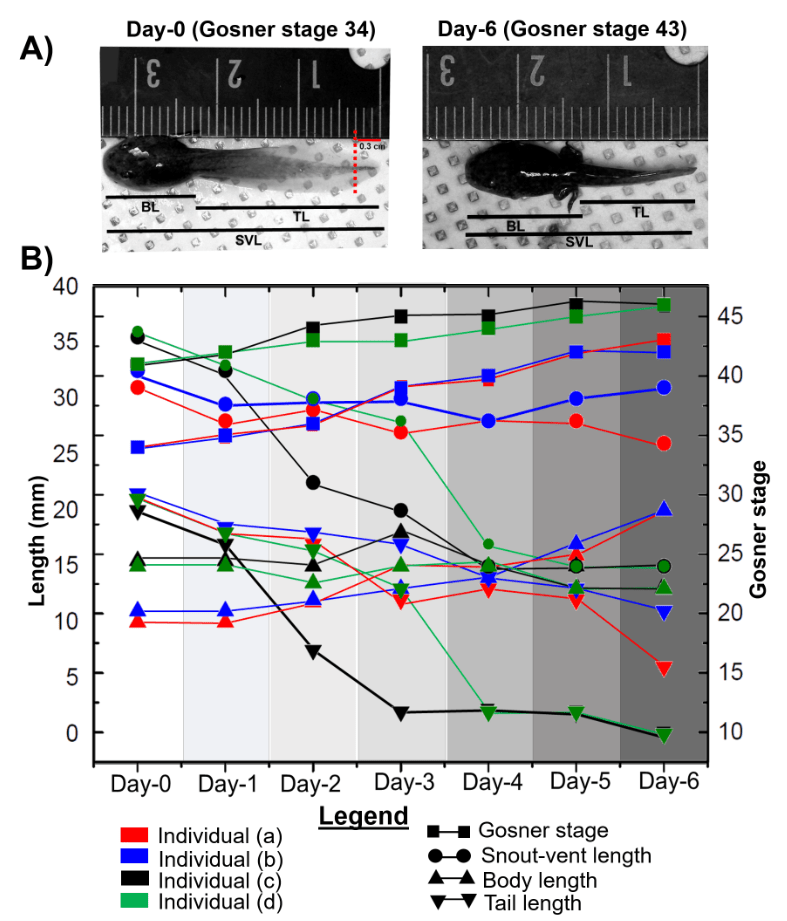
While tail clipping of amphibian tadpoles is known to be one of the minimally invasive methods for genetic sampling, there is a lack of published standard and safe protocol. Here we determined the efficiency of a protocol where we tail clipped 3.0 mm of four Rana huanrenensis tadpoles, matching with attempted predation in the wild.

Tail clipping, growth and development of Rana huanrenensis tadpoles

We observed the tails resorbing from tail length = 20.625 ± 0.64 mm on day 0 post-clipping to 5.75 ± 3.49 mm on day 6 post-clipping. During this period, metamorphosis progressed for individuals tail-clipped at Gosner stage 34 (total length: 33.75 ± 2.35 mm; day 0 post-clipping) to Gosner stage 43 (total length: 28.5 ± 3.47 mm; day 6 post-clipping); and individuals tail-clipped at Gosner stage 41 (total length: 35.75 ± 0.35 mm; day 0 post-clipping) to Gosner stage 46 (total length: 15.00 ± 0.00 mm; day 6 post-clipping). We did not record any fatality during the experiment.

Evidence supporting tail clipping 3 mm of tissue from the tail of Rana huanrenensis tadpoles

DNA extracted from 3.0 mm of tail tip tis-sue yielded gDNA concentrations between 10 and 32 ng/μl, a sufficient amount for barcoding and fingerprinting. We conclude that this protocol is adequate for R. huanrenensis and Ranidae in general, and it is safe for tadpoles at Gosner stage 34 and above.

Othman S. N, Chuang M-F., Kang H., Bae Y., Kim A., Jang Y. & Borzée A. (2020) Methodological guidelines for minimally invasive tail-clipping: a case study from Rana huanrenensis tadpoles. Asian Journal of Biological Conservation. 9(2):188-195.

COVID-19 and wildlife conservation in Asia

Many diseases, such as the one resulting from COVID-19, have crossed the barrier from animals to humans, with serious consequences. Together with members of the Society for Conservation Biology – Asia Section, we published a commentary in Trends in Ecology & Evolution where we highlight that epidemics originating from animal hosts are inevitable unless urgent actions to protect the environment and decrease the interface wildlife-domestic animals-humans are taken.

Currently, wildlife trade, degradation of natural habitats, and the interaction and interface between humans and wildlife leads to zoonoses such as coronavirus disease 2019. A shift away from the current practices through enhanced and proactive regulation of trade and reduction in environmental degradation would decrease the risk of zoonoses and benefit environmental conservation. Abbreviations: EIA, Environmental impact assessment. We are grateful to Benjamin Michael Marshall for help with the figure.

In the last thirty years, the majority of human pathogens which have caused substantial damage to human health and economies have originated from wildlife or livestock. Such diseases include Ebola, AIDS and SARS. COVID-19 is among the latest of these zoonotic diseases and resulted in a pandemic that has caused more than a million deaths worldwide.

Two primary factors that facilitate such outbreaks are wildlife trade and loss of natural habitat, both of which increase the frequency and potential for direct contact between humans and wildlife. Animals in wildlife markets are often housed in overcrowded and unsanitary conditions that create the perfect environment for pathogens to jump to humans. In addition, natural habitats are being cleared to meet the growing demands of an increasing human population, which puts livestock and people in closer contact with the wild hosts of potential zoonotic pathogens. Addressing these two factors will help prevent future zoonotic diseases.

In order to protect against future pandemics, we call for governments to establish effective legislation addressing wildlife trade, protection of habitats and reduction of interaction between people, wildlife and livestock.

You can find the final publication here, and a nice press release here.

Frog ladders

While conservation research is the main focus of the lab, getting dirty and applying conservation practices is also important, especially for pilot project.

The Korean landscape is heavily marked by deep water drainage ditches used to flood rice paddies, and these drainage ditches generally turn into death sentence to amphibians that become trapped. This problem has been acknowledged in the past, and some mitigation measure are implemented, but generally not in line with the behaviour of the species, and rarely used.

Escape ramps from drainage ditches, with a dried frog (Rana sp.) on the front right of the image as it did not find the ramps.

This mismatch was repeatedly noted, and recently a new type of escape ladder was trialed, after showing a marked success in the UK. This earlier project was organised in coordination with citizens and generated widespread interest by several environmental groups.

As a result, the lab was involved in providing scientific guidelines to the Hanns Seidel Foundation Korea, local branches of the Korean Federation for Environmental Movement and Goseong County to install frog ladders in Songjeong-Ri, Goseong, to help amphibians escape from drainage ditches. Three types of ladders were trialed, taking into account access by amphibians and water flow disruption so that ditches would not be removed by excavators cleaning the drains.

Frog ladders installed for amphibians to escape water drainage ditches.

Ladders were installed towards rice fields for amphibians migrating towards their breeding habitat to be able to escape, and towards the forest so that migration towards the hibernation habitat would not be blocked. The results of the three type of ladders installed will be compared, and Goseong County pledged to install more of the successful type.

Applied conservation at work! Some press released followed the event, follow these links [1], [2], [3] for more (in Korean).

An individual Pelophylax nigromaculatus (Black-spotted frog) trapped in a water drainage ditch at the site.