Borzee A., Zhang X., Prasad V.K., Wang R., Wang Z., Qin S., Messenger K.R., Guo T., Jang Y. Wang J. (2026). From Least Concerned to Endangered? An integrated approach to determine the distribution, suitable habitat and future of Dryophytes immaculatus. BMC Zoology. 11:2. DOI: 10.1186/s40850-025-00248-w
The immaculate treefrogs, Dryophytes immaculatus, were reported to be abundant in the plains of southern Jiangsu, China, until the 1980s. However, the species has scarcely been seen since the beginning of the century.
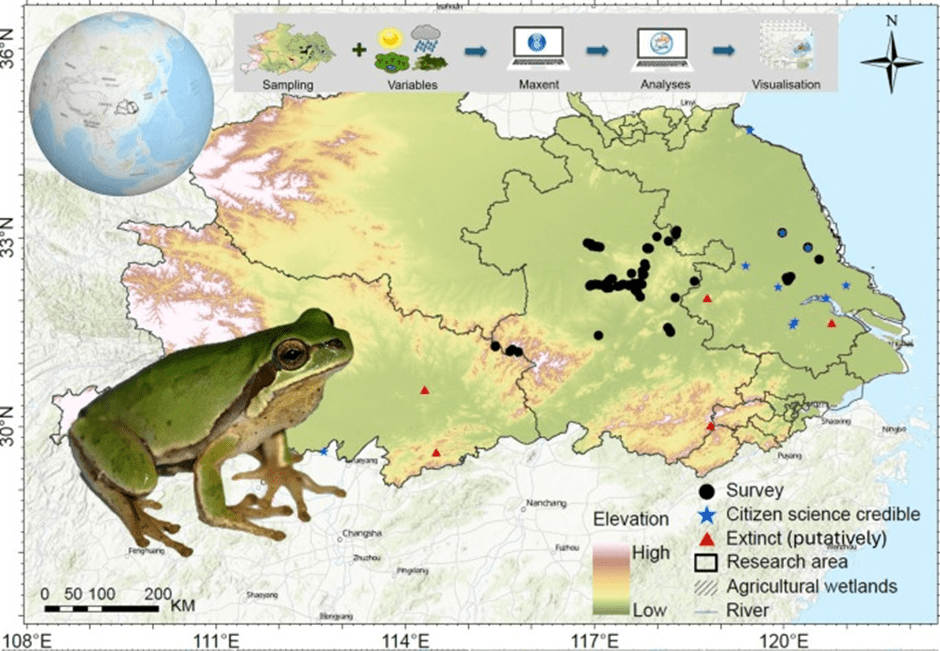
In our latest paper in BMC Zoology, We conducted field surveys at more than 6000 independent sites between 2017 and 2025, citizen science surveys resulting in more than 1300 entries, and questioned farmers, when possible, to determine the occurence and presence of D. immaculatus. We detected the species at 210 independent sites, obtained 12 additional independent sites from the citizen science data, and confirmed its local extinction at eight additional sites.
Current distribution of Dryophytes immaculatus.
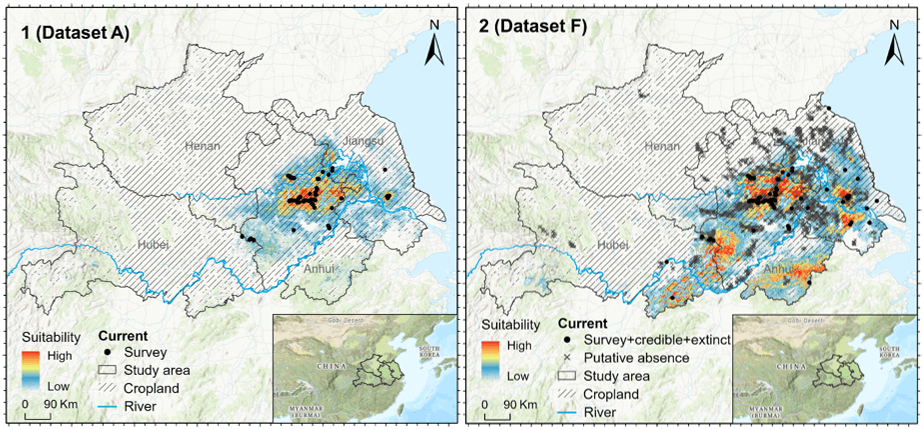
The model for the current timeline identified suitable habitat in an area marginally broader than the one where the species is currently found.
Ecological models representing the current suitable habitat of Dryophytes immaculatus.
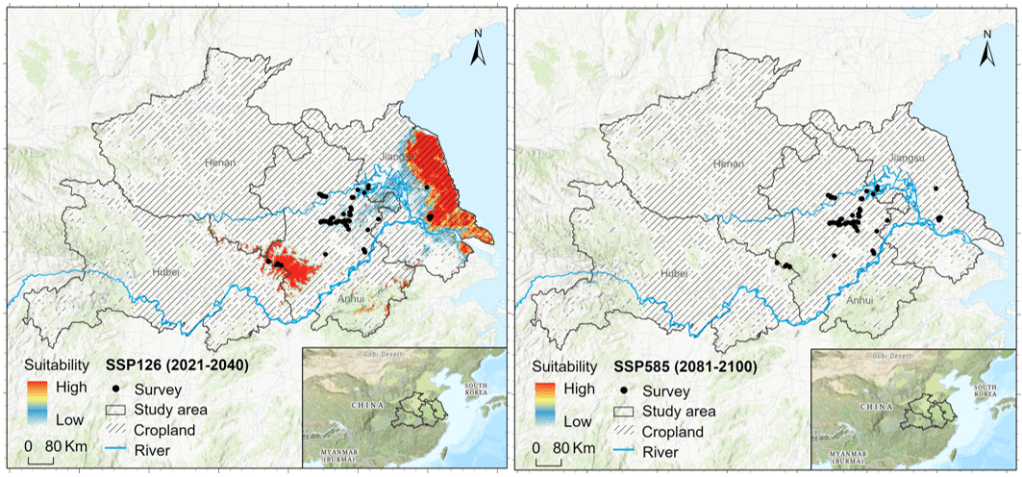
The climate change scenario models highlighted a shift in the location of the suitable habitat for all scenarios and time periods tested, with a weak overlap with the current distribution of the species.
Ecological models representing the future suitable habitat of Dryophytes immaculatus, under different climate scenarios.
Based on the data accumulated, we could also apply the categories and criteria of the IUCN Red List of Threatened Species, and we suggest the species to be listed as Endangered under both criteria B2ab (i, ii, iii, v) based on geographic range, and C2a (i) based on the small and declining population size.
The range of D. immaculatus has contracted over the last decades, fast enough for people sharing their land with the species to remember them. In addition, the habitat suitable for the species keeps on declining, and it is predicted to entirely collapse in all future climatic scenarios. While not Critically Endangered yet, D. immaculatus is in need of conservation actions, especially to prevent future decline in habitat quality due to human activities.
Borzee A., Zhang X., Prasad V.K., Wang R., Wang Z., Qin S., Messenger K.R., Guo T., Jang Y. Wang J. (2026). From Least Concerned to Endangered? An integrated approach to determine the distribution, suitable habitat and future of Dryophytes immaculatus. BMC Zoology. 11:2. DOI: 10.1186/s40850-025-00248-w
A new global reviewsynthesises conservation status assessments and decades of amphibian conservation research to reveal the latest trends in conservation status and outline priority actions for their protection. The findings underscore the alarming rate of declines, but also highlight promising signs of recovery where conservation is working. The authors stress that coordinated international action is essential to secure the future of frogs, salamanders, newts, and caecilians worldwide.
Amphibians continue to face an unprecedented high extinction risk, with 41% of species classified as threatened. The main drivers of threat include habitat loss, climate change, disease, pollution, and invasive species. The new review “Conservation Priorities for Global Amphibian Biodiversity“, led by Prof. Amaël Borzée, presents the most comprehensive synthesis to date of conservation progress, population trends, and policy measures guiding amphibian protection efforts worldwide.
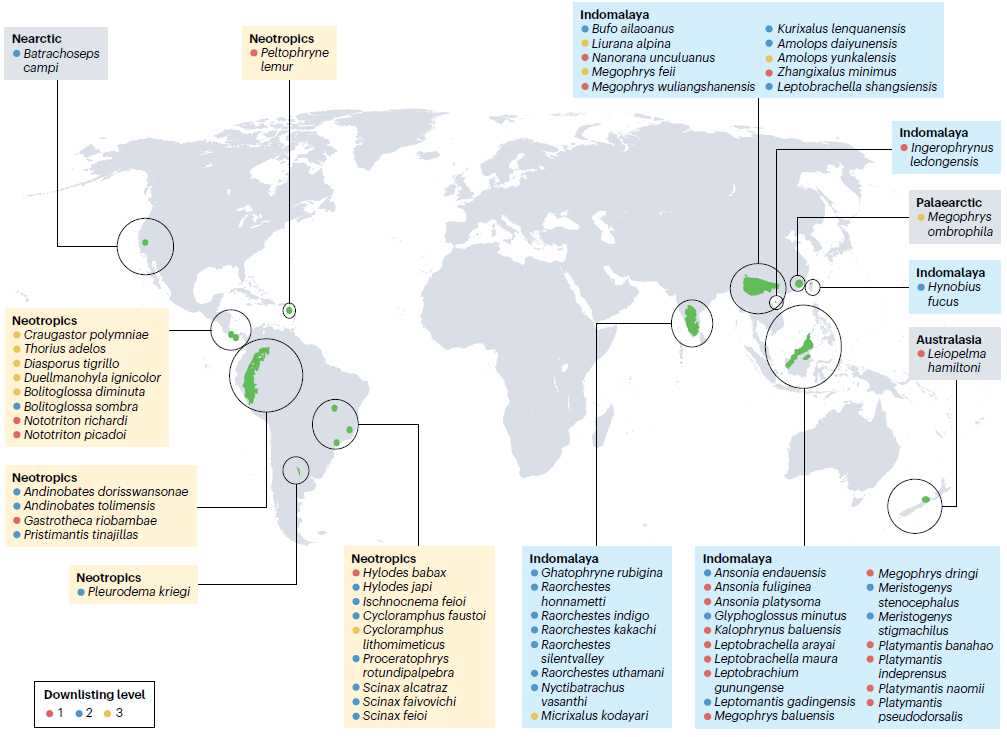
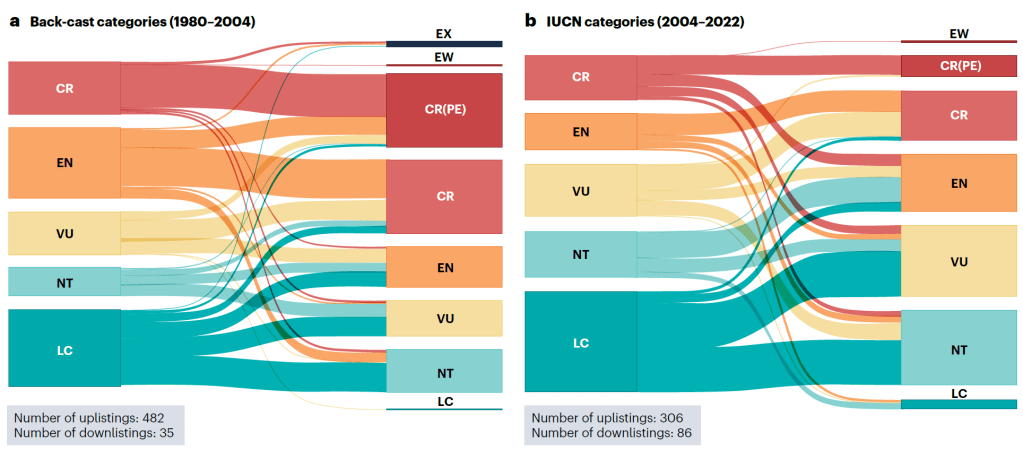
Extract showing temporal and regional variation in threat status. a, Category changes from 1980 to 2004 using backcast categories from the second Global Amphibian Assessment (GAA2) (517 species). b, Category changes from 2004 to 2022 using backcast categories from the GAA2 (392 species).
Since 1980, the conservation status of hundreds of amphibians has worsened, with 37 species now confirmed extinct, and another 185 have disappeared and are potentially extinct. Disease has been the primary driver behind many of these declines and remains a critical challenge for conservation efforts. Yet the review also highlights meaningful progress: the conservation status of 120 species has improved, thanks to effective habitat protection, targeted management, and dedicated recovery programs.
Example of some of the research conducted by the lab to help understand the population trends in amphibians in northeast Asia, and how to mitigate the losses.
Global prioritisation tools, such as Threatened Amphibian Landscapes (TAL), Highly Threatened Genera, and Key Biodiversity Areas, are proving essential for guiding strategic investment and identifying priority sites and species for action, and the global Amphibian Conservation Action Plan provides evidence for methods that work. These tools help ensure that limited resources are focused where they will deliver the greatest conservation impact. Meanwhile, biodiversity indicators such as the IUCN Red List Index and the Green Status of Species Index continue to advance our understanding of conservation progress and the potential for species recovery.
While improvements in the conservation status of some species demonstrate the potential for recovery with targeted conservation action, the authors caution that current efforts remain insufficient. Long-term success will require conservation actions that align with global commitments, including the Kunming–Montreal Global Biodiversity Framework. Only through strengthened collaboration between governments, conservation organisations, research institutions, and local communities can we shift amphibians worldwide from crisis toward recovery.
As the need for sustainable pest management grows, integrating animal cognition into biological control presents an innovative and effective approach. In our recent paper, “Biological pest regulation can benefit from diverse predation modes”, we explore the critical role of amphibians and reptiles in natural pest regulation, emphasising the cognitive mechanisms that drive their foraging behaviour.
Amphibians and reptiles, with their diverse predation strategies—ambush and active foraging—are key to efficient pest control. These species exhibit distinct cognitive traits, from perception and learning to spatial memory, all of which influence their interaction with prey. For instance, ambush predators rely heavily on movement cues, waiting for mobile prey, while active foragers actively seek out food, utilising olfactory and spatial cues to navigate their environment.
Overview of the concept showing the difference in foraging mode between active and ambush predators impacting biological pest regulation (with amphibians as the model bioregulator). More here: 10.1098/rsos.240535
By understanding these cognitive processes, we can develop more targeted strategies to keep pest management evolving. As agricultural landscapes become more fragmented and ecosystems face increasing pressure, tapping into the behavioural flexibility of amphibians and reptiles offers a promising path. Their cognitive abilities not only make them efficient bioregulators but also provide a natural, environmentally friendly alternative to chemical pesticides, aligning pest control with biodiversity conservation. The future of pest management lies in understanding and leveraging these animal behaviours for both ecological and agricultural benefits.





 Laboratory of Animal Behaviour and Conservation