I’m leading the Laboratory of Animal Behaviour and Conservation at Nanjing Forestry University, where we focus on a broad range of species. Projects were so far focused on the behavioural ecology and conservation of amphibian species in East Asia, but this is changing and you are welcome to inquire, maintaining a focus on North East Asia.
The lab’s latest publication focuses on Hoplobatrachus chinensis, a frog species that lives mainly in plains and hilly landscapes at altitudes between 20 and 1120 m. It is commonly found in moist habitats such as agricultural wetlands, ditches, and ponds in East and Southeast Asia. The species is generally present in rice paddies and their surrounding areas, as rice paddies provide the necessary conditions for development, growth, and breeding, such as shallow, slow-moving water bodies, surrounded by moist surface soils, abundant food sources, and adequate sheltering micro-habitat. In recent decades, due to human disturbance, over-harvesting, and ecological degradation, H. chinensis has declined sharply in population density and distribution area.
Geographic locations of Hoplobatrachus chinensis. A: H. chinensis adult, photograph by Vishal Kumar Prasad; B: H. chinensis eggs, photograph by Amaël Borzée.
Therefore, in order to explore the effects of climate change and dispersal ability on the range of H. chinensis and its occupation of agricultural wetlands, we use survey records and secondary sources (Global Biodiversity Information Facility database), together with climate, geography and vegetation data, to build environmental niche models in MaxEnt and dispersal models in MigClim to assess the impacts of climate change and dispersal ability on the range of H. chinensis. Based on the model results, we calculated the overlap between suitable habitats and agricultural wetlands.
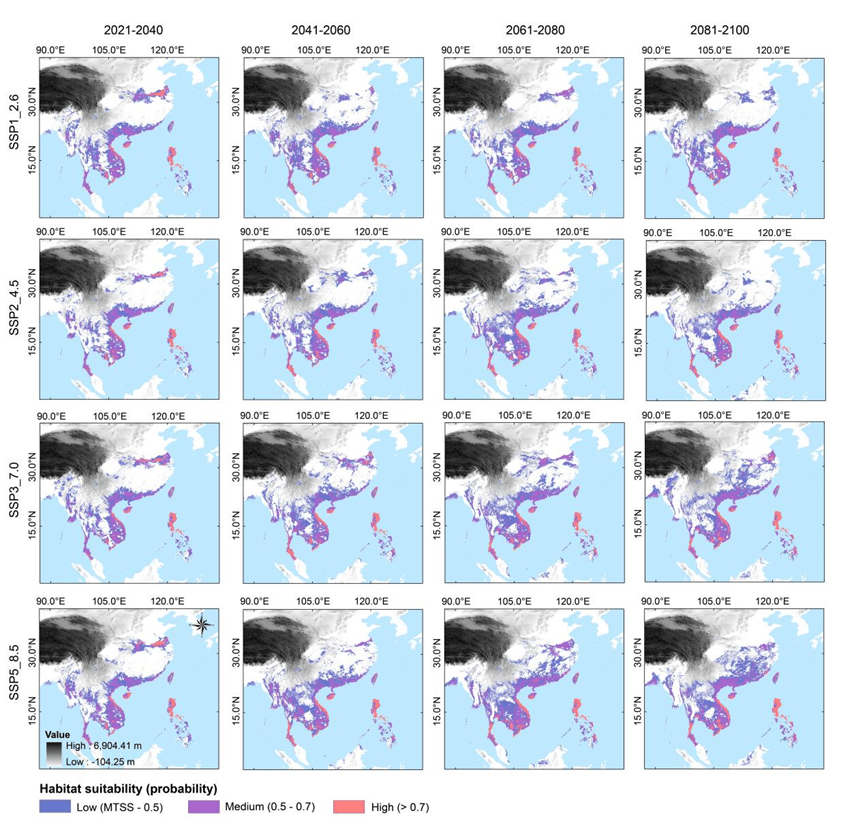
Projected future potential suitable habitats for H. chinensis from 2021 to 2100 under four emissions scenarios. Classification of future potential suitable habitats was refined using ArcGIS 10.6 by maximum training sensitivity plus specificity thresholds (MTSS).
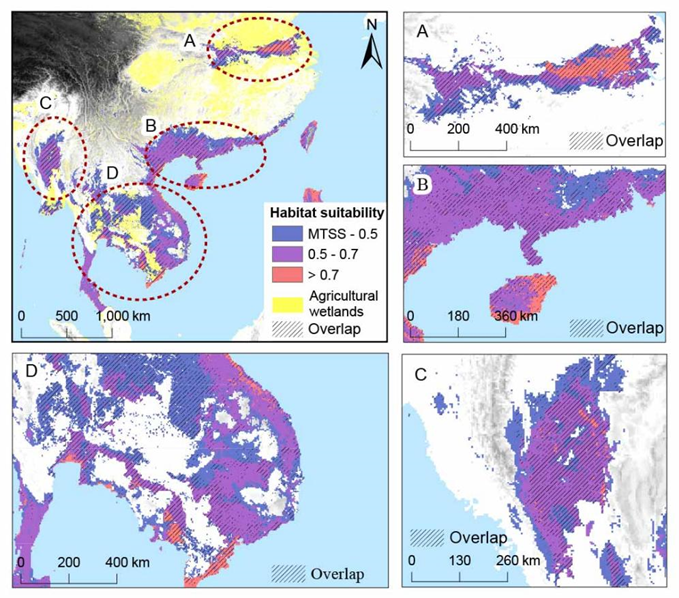
The models indicated that temperature was a key factor affecting H. chinensis distribution. Increasing temperatures positively correlated with habitat suitability, with suitable habitat expanding northward by 2060 while maintaining suitability in the southern parts of the range. We found a 25.18% overlap between the current potential suitable habitat of H. chinensis and agricultural wetlands. MigClim model indicated that H. chinensis might be able to track shifts in suitable habitats under climate change given a 15 km dispersal ability per generation. Climate change will likely expand suitable habitat for H. chinensis. Our predictions offer important guidance for the conservation of the species, especially for the integrated role of natural and agricultural wetlands such as rice paddies.
Projected overlap between the suitable habitat and agricultural wetlands under the current climate scenario for H. chinensis in East Asia. The overlap area was calculated using ArcGIS 10.6. A: Focus on Jiangsu, Anhui and Hubei in China; B: Guangxi, Guangdong and Hainan Island in China; C: Myanmar; D: Thailand, Cambodia, Lao PDR and Vietnam.
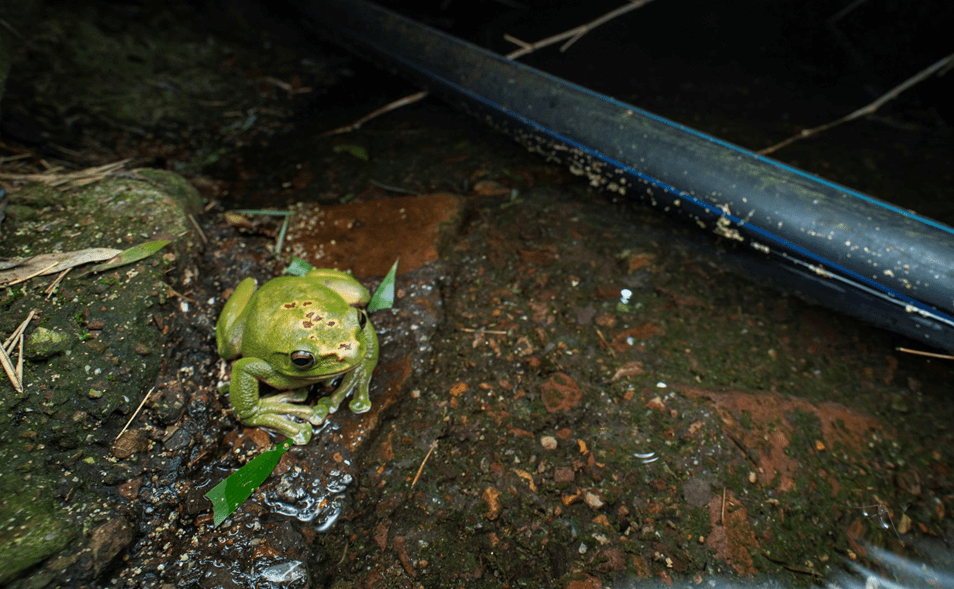
The lab’s latest publication started with a big green blob sitting next to a stream. The oversized leaf-colored lump was a Dennys’ large treefrog (Zhangixalus dennysi), a species of frog that was a real surprise for all of us there that night. The Chinese name for this species is 大树蛙, which translates literally to “big tree frog,” and these frogs certainly live up to the name, with the largest individuals exceeding ten centimeters in length. Their oversized feet and large toe pads are perfectly suited for a life in the trees, though the first one we encountered that night was hanging out next to the streambed. Their fingers and toes are even webbed to help them glide between branches.
The first Dennys’ large treefrog we encountered, photographed in situ by Kenneth Chin, a wildlife photographer and artist from Singapore who had joined us on the expedition.
Over several nights of surveys in the southernmost portion of Jiangsu Province in September 2023, the lab encountered several species of animal that we later realized had few or no previous records of in the province. All five of these species—four frogs and one snake—have larger ranges further south, but the extent of their distribution within Jiangsu Province was a mystery.
Four of the species encountered during our surveys. Photographs a, c, and d from Kenneth Chin; b from Zhenqi Wang.
The four frogs we encountered with limited documentation in Jiangsu Province: a) Dennys’ large treefrog (Zhangixalus dennysi) 大树蛙; b) white-lipped treefrog (Polypedates braueri) 布氏泛树蛙; c) broad-folded frog (Hylarana latouchii) 阔褶水蛙; d) Tianmu odorous frog (Odorrana tianmuii) 天目臭蛙. The snake (the brown spotted viper, Protobothrops mucrosquamatus, 原矛头蝮) is not pictured as it was less photogenic, having been killed and mutilated by people, unfortunately.
Using our own survey records, the existing locality records for these five species, and climate data on temperature and precipitation, we used environmental niche modeling to see how much other habitat in Jiangsu would be climatically suitable for these five species.
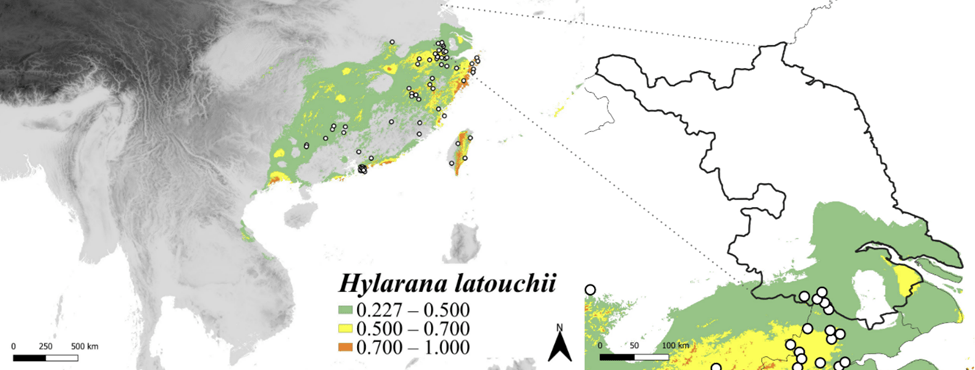
The resulting suitability map for the broad-folded frog (Hylarana latouchii)阔褶水蛙, one of the five species we modeled, with a view of its entire range on the left and a close-up of Jiangsu Province on the right. Green indicates the minimum predicted threshold for viable habitat, with yellow and orange indicating moderately and highly suitable areas.
The models indicated that, at least from a purely climatic standpoint, there is more viable habitat for all four frog species within Jiangsu, so perhaps in the future they’ll be found even further north than we found them. The model for the viper species didn’t show suitable habitat within Jiangsu, but as the climate warms this subtropical species may work its way further north anyway. To view the maps for the other four species or read more details, the full paper is free to read at https://doi.org/10.3897/herpetozoa.37.e117370.
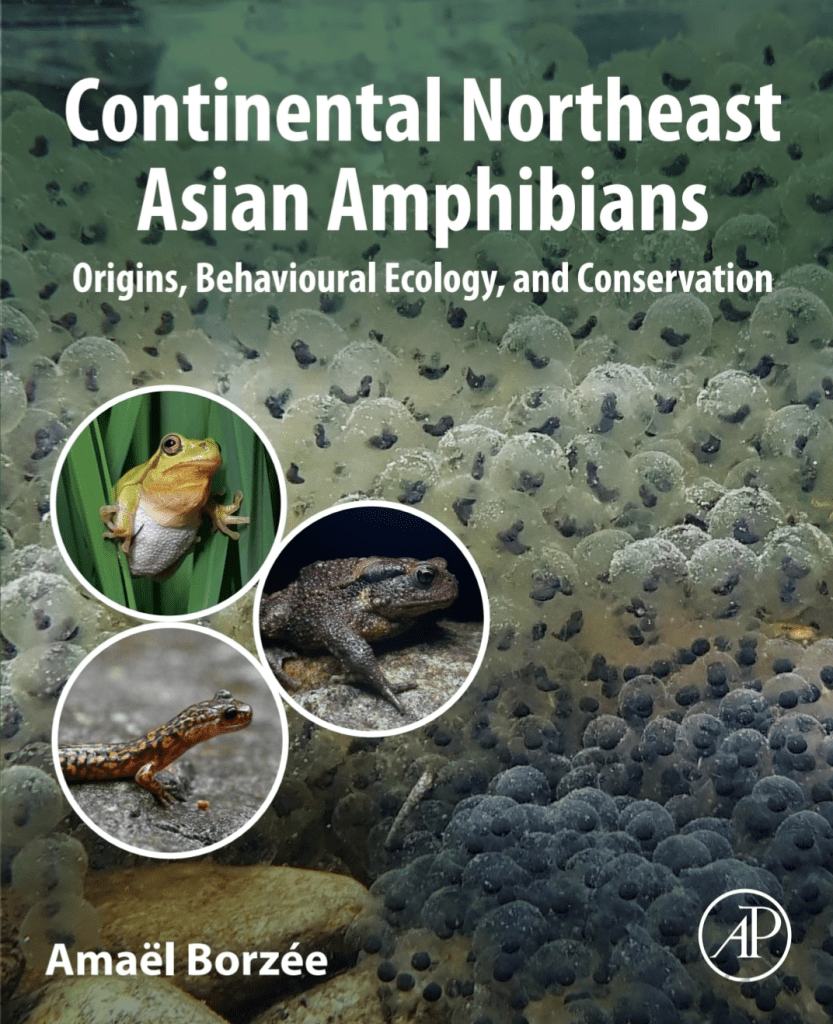
New book published by the lab, available from Elsevier.
“Continental Northeast Asian Amphibians: Origins, Behavioural Ecology, and Conservation is the only comprehensive compilation of knowledge on the amphibian species of continental northeast Asia. Along with accounts for each species, the book introduces the biogeographic history, behavioral patterns, ecological requirements, and threats in the region. Written by a leading expert on Asian amphibians, this book delves into the details of origin and life history and distinguishes which variables have been instrumental to the distribution of populations and amphibian biodiversity in this region. Sections provide detailed accounts for field identification and range of the species’ behaviour during both breeding and non-breeding seasons. Finally, the book provides in-depth accounts on the threats and trends for each species, considering the current conservation pressure in the region. Each point is explained in relation with the very contrasted landscapes of the region that include two rather different species assemblages, one on the alluvial plains and the other at higher elevation on mountain ranges”.
New paper on amphibian habitat connectivity in collaboration with Mr Peng and Prof Lifrom Yanbian University! This research project started when wondering about habitat suitability and connectivity for the least studied amphibian of northeast Asia: the Clawed Salamanders! 与延边大学的彭玉玺和李颖老师的合作,在两栖动物栖息地连通性方面的新论文!这个研究项目始于对东北亚少有研究的两栖动物——爪鲵的栖息地适宜性和连通性的好奇!
Research area and Clawed Salamander record points used for modeling. The origin of the sample data includes field sampling, published references, and open data sets. The boundary data came from the College of Geography and Ocean Science, Yanbian University. 研究区和用于建模的爪鲵记录点。样本数据的来源包括现场采样、已发表的参考文献和开放数据集。边界数据来自延边大学地理与海洋科学学院.
Human activities and climate change have caused damage to the natural world, leading to increased attention on habitat protection. However, most conservation efforts focus on flagship species, while many other species lack protection and are gradually becoming extinct due to the lack of conservation efforts and public attention. 人类活动和气候变化对自然界造成了破坏,引发了对栖息地保护的日益关注。然而,大多数保护努力都集中在代表性物种上,而许多其他物种缺乏保护,由于缺乏保护措施和公众关注而逐渐灭绝。
The Liaoning clawed salamander (Onychodactylus zhaoermii) and the Jilin clawed salamander (Onychodactylus zhangyapingi) are two amphibians endemic to Northeast Asia, but they have not received enough conservation attention, and little is known about their distribution. In this study, we collected field survey and literature data for both species to obtain data on occurrence, and constructed ecological niche models to understand their suitable habitat and potential distribution. 辽宁爪鲵(Onychodactylus zhaoermii)和吉林爪鲵(Onychodactylus zhangyapingi)是东北亚特有的两种两栖动物,但它们并没有受到足够的保护关注,对它们的分布了解甚少。在本研究中,我们收集了两种物种的野外调查和文献数据,获取了出现数据,并构建了生态位模型,以了解其适宜的栖息地和潜在分布情况。
Habitat suitability distribution and species presence-absence maps for Onychodactylus spp. These models were selected from the seven selected models after tuning, based on the methods described in the text. 爪鲵属的栖息地适宜分布和物种存在/缺失地图。这些模型是在优化调整后从七个选定的模型中选择的,基于文本中描述的方法。
The ecological niche models revealed that the suitable habitat of the Jilin Clawed Salamander was primarily located within the Yalu River basin, as well as the western and eastern mountains of the Democratic People’s Republic of Korea (DPR Korea). On the other hand, the suitable habitat for the Liaoning Clawed Salamander was mainly distributed in the Xiuyan area of Liaoning in China, the Changbai Mountains, and north of the Tumen River basin. Although there is currently no direct evidence of the species’ presence in DPR Korea, the ENM results support their putative presence in the nation, as there are large patches of suitable habitat. 生态位模型显示,吉林爪鲵的适宜栖息地主要位于鸭绿江流域,以及朝鲜的西部和东部山区。另一方面,辽宁爪鲵的适宜栖息地主要分布在中国辽宁的岫岩地区、长白山地区和图们江流域北部。尽管目前没有直接证据表明这两个物种在朝鲜存在,但生态位模型结果支持它们可能存在于该国,因为存在大片适宜栖息地。
Corridor connection for Onychodactylus species in the transboundary area between China and DPR Korea. We identified 11 continuous patches larger than 1000 km2 on the presence/absence map of the Onychodactylus genus. These nodes are named and indexed with blue circle markers, labeled 1–11 on the map. Our findings reveal that the highest overall current density was 0.6726, concentrated in the purple area, indicating the highest current density and a potential corridor. 中朝跨境地区的爪鲵属栖息地之间的廊道连通性。我们确定了11个超过1000平方公里连续区域的爪鲵属的存在/缺失地图。这些节点用蓝色圆圈标记,并在地图上标为1-11。我们的研究结果显示,最高的总体流密度为0.6726,集中在紫色区域,表明有最高的流密度和潜在的廊道。
In addition, the connectivity model showed the presence of transboundary corridors between patches of suitable habitat, with some nodes (here defined as continuous patches of habitat enabling connection between suitable habitats) located in multiple provinces or within different countries. In our evaluation of the transboundary corridors in the eastern and western parts of the study area, we found that the surfaces located downstream along the Tumen River showed a better quality for a corridor. However, the gradual fragmentation and disappearance of the landscape may lead the two species to extinction. 此外,连通性模型显示了适宜栖息地之间存在的跨界走廊,其中一些节点(定义为能够连接适宜栖息地的连续栖息地片)位于多个省份或不同国家内。在对研究区域东部和西部的跨界走廊进行评估时,我们发现沿图们江下游的表面更适合作为走廊。然而,陆地逐渐破碎和消失可能导致这两个物种灭绝
Therefore, we recommend establishing a transboundary amphibian protection network in the China-DPR Korea river basin and encouraging collaborations for amphibian surveys and applied conservation projects in the Tumen River basin. 因此,我们建议在中朝流域地区建立跨国境两栖动物保护网络,并鼓励在图们江流域进行两栖动物调查和应用保护项目的合作。
The illegal trade in wildlife has introduced various species to new environments worldwide, including amphibians. Invasive species have harmful effects on local species through competition, predation, and other ecological interactions, including introducing non-native pathogens. Several species in the focus area of this study, including Rana huanrenensis, have been introduced to offshore islands in the Republic of Korea.
Rana huanrenensis from the Republic of Korea.
The Republic of Korea has a significant amphibian trade, including live animals for both pet trade and human consumption. The trade originates mainly from China and the USA and has grown significantly over the past two decades. As a result, some amphibian species have been designated as Alert Alien Species and invasive species, such as the American bullfrog, and have caused a severe loss of aquatic biodiversity. Eradicating invasive species is very complicated and expensive, making prevention of introduction the most cost-effective approach.
The Republic of Korea imports live Brown frog (Rana) individuals from China for human consumption, and this trade was conducted legally as some native species of the Republic of Korea can be legally traded. However, Rana uenoi, which is endemic to the Korean Peninsula and Tsushima Island in Japan after being split from the Rana dybowskii species complex cannot be legally traded anymore.
The Republic of Korea imports not only legally traded species but also non-native frog species that are morphologically similar to native ones, including Rana amurensis, Rana chensinensis, R. dybowskii, Rana kukunoris and Rana taihangensis. Once traded, some individuals may be released into nearby streams at the end of the legal sale period for welfare reasons, but this is a biosecurity threat because the frogs are not scanned for pathogens, and the African Swine Fever and Avian influenza pandemics have shown how quickly pathogens can spread. In addition, there is a threat of establishment, and hybridisation with local species.
International trade towards Korea requires updated regulations based on science-based recommendations to prevent the loss of biodiversity. Policy recommendations have the potential to help update national laws, especially in the case of the trade of invasive species. A policy recommendation on the trade of invasive American bullfrogs towards the Republic of Korea has coincided with a regulatory update in the trade of amphibians, but the discovery of non-native Rana species in the trade calls for additional updates in regulations. This policy recommendation has the potential to lead to further legal adjustments in the trade of the genus.
Risks of invasion
Amphibian trade can result in invasive species, causing two threats to the survival of native species. These threats include ecological interactions and pathogen dispersion, both of which have been documented in the invasive American bullfrog in the Republic of Korea. This species has impacted the ecology of native amphibians, reptiles, and birds, as well as increasing pathogen loads on native species.
Many Rana species have similar ecological requirements, and the impact of interactions between species pairs is unknown. Geographically distant clades of a single species may have significantly divergent ecological requirements, and displacement of individuals due to the introduction of non-native Rana species can result in competition and hybridisation, driving the extirpation of native Rana species. The negative effect of displacement can also be within a single species, resulting in individuals less adapted to the local environment or even species losses. Hybridisation can also magnify the invasive capacity of a species.
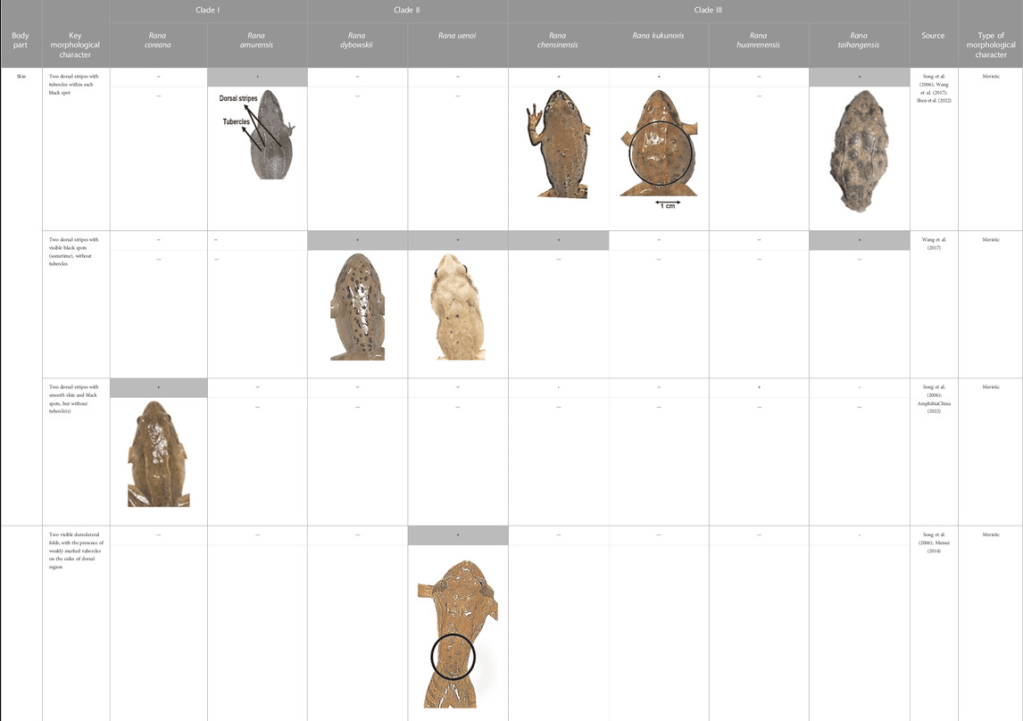
Morphological identification key to identify continental northeast Asian Rana
Rana species can transfer two major pathogens: Ranavirus and the chytrid fungus Batrachochytrium dendrobatidis (Bd). There have been mortality events occurring in both captive and wild populations in the Republic of Korea due to Ranavirus. Even if non-native Rana species have not been involved in these events, they pose a risk of escape from farms, and Ranavirus prevalence is higher in invasive Ranids in the Republic of Korea. Rana species can also be reservoirs for Bd, and the introduction of non-native Bd strains could have deadly effects. Therefore, the introduction of Rana species across natural boundaries can have disastrous consequences for local populations, including local extirpation.
The Republic of Korea’s Fourth National Biodiversity Strategy (2019-2023) contains action plans to address threats to biodiversity, including establishing mechanisms to control human-mediated species introduction and strengthening policy responses and post-introduction control of invasive species. The strategy also aims to protect endangered and endemic species and strengthen research and response to wildlife diseases, along with an improved wildlife rescue and care system. These actions are in compliance with legal obligations established by the Convention on Biological Diversity.
Current laws in the Republic of Korea allow for the import and captive breeding of certain Rana species with a permit, but measures are needed to prevent the introduction and establishment of non-native species that could harm native populations. Amphibians will soon be designated as aquatic organisms and regulated similarly to fishery products. Trade bans have already been implemented for some species in the Republic further strengthened.
Actionable recommendations
To prevent the introduction of new alien populations of Rana in the Republic of Korea, a ban on trading non-native Rana species should be implemented. This ban should also include domestic trade, specifically preventing the trade of R. uenoi from Jeju Island on the mainland. However, dead specimens of certain Rana species may be allowed for trade if it does not impact conservation efforts, and to prevent escapes and the release of pathogens.
To prevent the establishment of new invasive alien populations and the spread of pathogens, the release of any alien specimens and their offspring originating from past trade should be banned. Authorities should also use emergency measures to prevent the risk of population depletion, track and control potentially invasive species, and conduct broad-scale surveys for ranavirus and chytrid fungus. An updated National Species List that includes R. uenoi and a species identification key should be established to aid in border control and trade regulation efforts.
Conclusions
Non-native Rana species have been traded legally into the Republic of Korea, but regulations have not kept up with advances in taxonomy. While the establishment of alien Rana populations has not been confirmed, monitoring of populations and the presence of pathogens is necessary to prevent their establishment. The trade of non-native species for human consumption should be banned entirely, with the trade of native species limited to processed products and verifiable data to avoid the risk of invasion. The focus should be on Rana dybowskii, Rana amurensis, Rana chensinensis, Rana taihangensis, and Rana kukunoris, with additional analyses needed for conservation.








 Laboratory of Animal Behaviour and Conservation