
The lab’s latest publication started with a big green blob sitting next to a stream. The oversized leaf-colored lump was a Dennys’ large treefrog (Zhangixalus dennysi), a species of frog that was a real surprise for all of us there that night. The Chinese name for this species is 大树蛙, which translates literally to “big tree frog,” and these frogs certainly live up to the name, with the largest individuals exceeding ten centimeters in length. Their oversized feet and large toe pads are perfectly suited for a life in the trees, though the first one we encountered that night was hanging out next to the streambed. Their fingers and toes are even webbed to help them glide between branches.
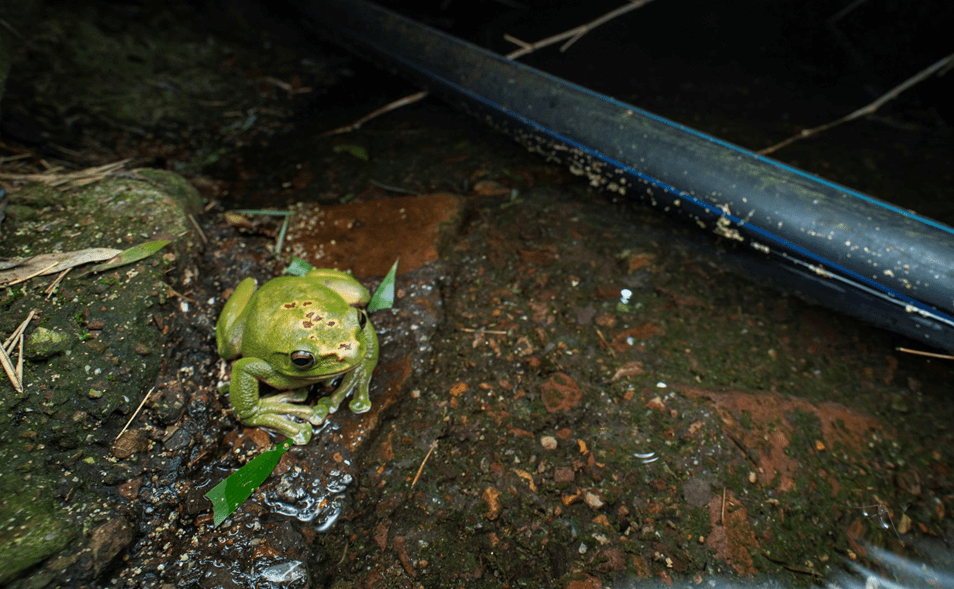
Over several nights of surveys in the southernmost portion of Jiangsu Province in September 2023, the lab encountered several species of animal that we later realized had few or no previous records of in the province. All five of these species—four frogs and one snake—have larger ranges further south, but the extent of their distribution within Jiangsu Province was a mystery.

The four frogs we encountered with limited documentation in Jiangsu Province: a) Dennys’ large treefrog (Zhangixalus dennysi) 大树蛙; b) white-lipped treefrog (Polypedates braueri) 布氏泛树蛙; c) broad-folded frog (Hylarana latouchii) 阔褶水蛙; d) Tianmu odorous frog (Odorrana tianmuii) 天目臭蛙. The snake (the brown spotted viper, Protobothrops mucrosquamatus, 原矛头蝮) is not pictured as it was less photogenic, having been killed and mutilated by people, unfortunately.
Using our own survey records, the existing locality records for these five species, and climate data on temperature and precipitation, we used environmental niche modeling to see how much other habitat in Jiangsu would be climatically suitable for these five species.
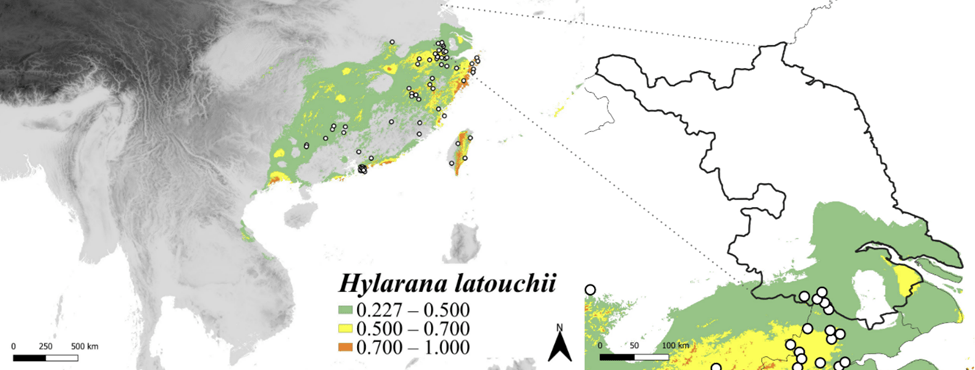
The models indicated that, at least from a purely climatic standpoint, there is more viable habitat for all four frog species within Jiangsu, so perhaps in the future they’ll be found even further north than we found them. The model for the viper species didn’t show suitable habitat within Jiangsu, but as the climate warms this subtropical species may work its way further north anyway. To view the maps for the other four species or read more details, the full paper is free to read at https://doi.org/10.3897/herpetozoa.37.e117370.

 Laboratory of Animal Behaviour and Conservation