
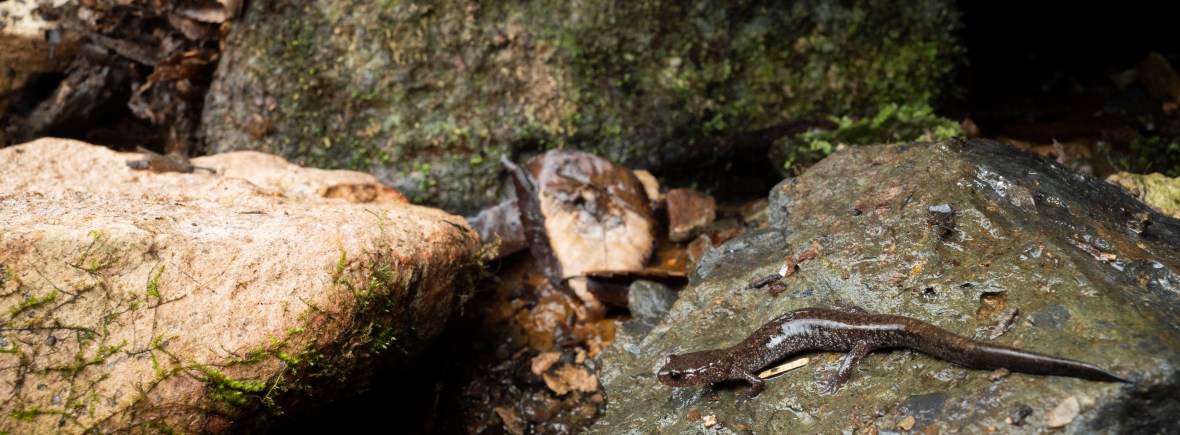
Karsenia (Korean Crevice Salamander)이끼도롱뇽

Karsenia 이끼도롱뇽속
Single species of its family in Asia
미주도롱뇽과는 허파가 없는 도롱뇽이며 팔레오기(신생대, 6,000~7,000만년 전)에 북아메리카에 처음 출현하였습니다. 그러나 미주도롱뇽과의 한 종을 제외한 나머지 종들은 아메리카와 남유럽에서 발견되었습니다. 이 과는 1억 년전에 분화되어, 4,000만 년전에 이끼도롱뇽속(Karsenia)를 포함하는 미주도롱뇽아과로 분화되었습니다.미주도롱뇽과의 많은 종들이 직접적인 진화 양상을 나타냅니다.
The Plethodontidae is a family of lungless salamanders that first emerged in North America during the Paleocene. All but one Plethodontidae species are found in regions of the Americas and southern Europe.
The family diverged a bit more than 100 million years ago, with the Plethodontinae subfamily, which includes the Karsenia genus, dating back around 40 million years. Many species within this family exhibit direct development.

Phylogeography and taxonomy / 계통지리와 분류
이끼도롱뇽 (Karsenia koreana)은 2005년에 한국의 장태산에서 처음 발견되었습니다. 고대의 이끼도롱뇽속 (Karsenia)은 4,200만년 전에 서북부 아메리카에서 동아시아로 이주하면서 Anides속에서 분화되었습니다. 이끼도롱뇽은 다른 미주도롱뇽과와 매우 유사하며 최남단 지역으로는 백운산에서 발견됩니다, 그리고 백두대간과 연결되는 북한의 최남단 지역에서도 발견될 가능성이 있습니다.
The Korean Crevice Salamander, Karsenia koreana, was discovered in 2005 on Jangtae Mountain in South Korea. The ancestor of Karsenia diverged from a clade with Aneides and migrated from western North America to Eastern Asia around 42 million years ago. This species closely resembles other Plethodontidae and can be found in the southern region of Baekun Mountain, along the Baekdu mountain range, and potentially in extreme southeastern DPR Korea.
Unknown breeding behavior
이끼도롱뇽은 아직까지는 야생에서 번식이 관찰되지 않은 신비로운 종입니다. 이끼도롱뇽은 9~10여년 정도의 수명을 갖고 있습니다, 또한 번식지가 비번식지와 매우 근접하여 분산되는데는 매우 제한적일 것이라 예상합니다. 준자연적인 서식지의 관찰 결과 이끼도롱뇽의 알은 4월에 발견되었으며 배발생입니다.
Karsenia koreana is a secretive species that has not been observed breeding in the wild. They have a lifespan of 9 to 10 years, and it is anticipated that their breeding sites are in close proximity to their non-breeding areas due to limited dispersal ability. Based on observations in semi-natural conditions, it has been confirmed that Karsenia koreana is a direct developer, with eggs typically found in April.

Conservation 보전
이끼도롱뇽이 멸종위기에 처한 이유는 여러 가지가 있습니다, 먼저 도시의 팽창화와 목재 채취로 인한 서식지 파괴가 있습니다. 기후변화 또한 심각한 위협 요인인데, 2070년에는 이끼도롱뇽의 서식할 수 있는 서식지가 없어질 것이라 예상합니다. 이끼도롱뇽은 넓은 분포와 많은 개체수로 인해 ‘관심 대상’ 등급으로 분류되어 있지만 특정 지역에서 단절되었으며 서식지 파괴로 인해 개체 수가 감소하고 있습니다. 또한 다른 집단과의 연결성이 없습니다.
Karsenia koreana is vulnerable to multiple factors, primarily habitat destruction caused by urban expansion and timber exploitation. Climate change is also a significant threat, with a projected loss of suitable habitat by 2070. Although considered Least Concern due to its wide distribution and abundance, K. koreana has been eradicated from certain locations and its population is decreasing due to habitat degradation. Additionally, there is no connectivity between different populations.

Adult

Sub-adult
 Laboratory of Animal Behaviour and Conservation